
TL;DR

Get wellness gear delivered free with Prime
- Fast, free delivery on millions of items
- Prime Video, Amazon Music and more included
- Member-only deals all year
Strength and conditioning coach Matt Van Mol shared four resistance-band exercises he says he uses most days to work on mobility: a shoulder rotation, banded cat-cow, kickstand hinge pulse and side bend. The routine uses a long-loop band and takes about four minutes, according to Fit&Well; the source does not report independent testing or evidence that it will work for everyone.
Strength and conditioning coach Matt Van Mol has shared a four-exercise resistance-band routine that he says he uses most days to work on mobility in his shoulders, hips and lower back. The Fit&Well report says the sequence takes about four minutes and requires a long-loop band, but the routine is Van Mol’s coaching advice, not a clinical assessment or a guarantee of results.
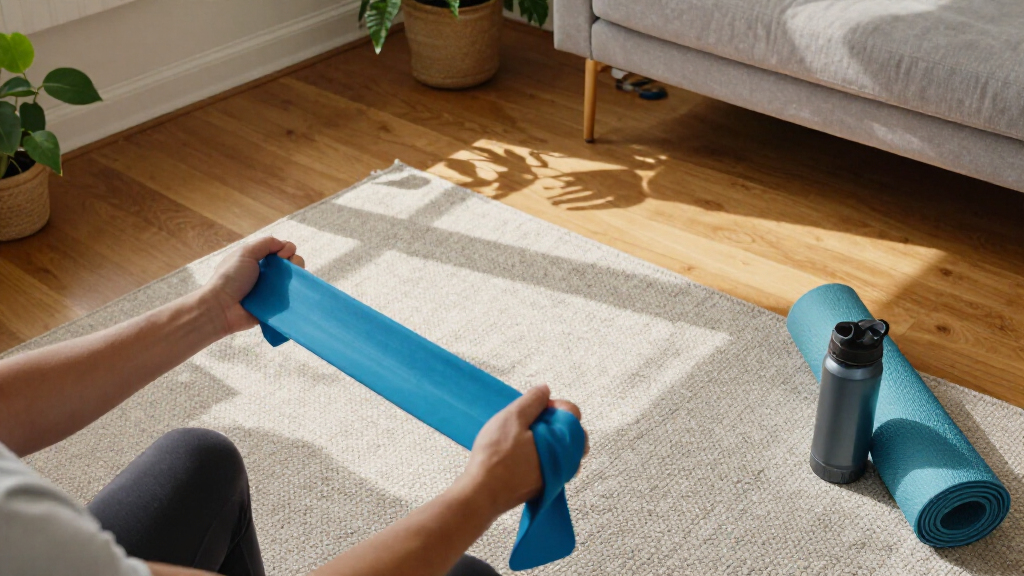
The four movements are a shoulder dislocation variation, a banded cat-cow, a kickstand hinge pulse and a band side bend. Fit&Well’s instructions recommend starting with the lightest resistance. The shoulder exercise is prescribed for 10 to 12 repetitions; the cat-cow lasts 60 seconds; and the hinge pulse and side bend are performed for 30 seconds on each side.
For the shoulder movement, hold a long-loop band with hands wide enough to keep it taut, raise it overhead and rotate it behind the body, then reverse the movement. The cat-cow is performed on hands and knees with the band gently pressing against the lower back, while the exerciser alternates between arching and rounding that section of the spine. Van Mol says the band’s pressure can provide feedback about which part of the back is moving.
For the hinge pulse, the band is looped around one foot and held in the opposite hand. The other foot steps back lightly as the person hinges at the hips and makes small pulses, then switches sides. In the side bend, the band runs from one foot to the hand on the same side; the person bends away from that resistance and then works against it in the opposite direction. These are the source’s movement descriptions, not individualized instructions for people with pain or restricted movement.
A Short Routine With Clear Limits
The report offers readers a brief sequence they can try with portable equipment, and gives specific durations and repetitions rather than presenting mobility as an unspecified stretching session. Van Mol’s account may be useful to people looking for a repeatable movement routine, especially because the exercises cover several areas rather than one joint alone.
But the claims about benefits remain the coach’s explanation of his approach. The supplied report does not cite a study testing this exact four-move sequence, quantify changes in mobility, or establish that it prevents or treats back pain. Readers should not treat the routine as a substitute for assessment or care when pain is persistent, worsening or accompanied by other symptoms.
Products Worth Considering

Fitbit Sense 2 Smartwatch – Blue Mist / Pale Gold

Levoit Core 400S-P Smart Air Purifier for Large Rooms (Up to 1,718 sq ft)

Oral-B iO Series 3 Rechargeable Electric Toothbrush for Adults, Black, 3 Modes, 2 Brush Heads and Travel Case
As an affiliate, we earn on qualifying purchases.
How Van Mol Describes Mobility
Van Mol, identified by Fit&Well as a strength and conditioning coach and co-founder of resistance-band company Strong Band, says years of lower-back pain informed the routine he developed. His personal history is context for his approach; it does not establish that the exercises will produce the same outcome for other people.
He defines mobility as more than the distance a person can stretch, describing it as the range of movement they can control. He says bands can assist someone into a position or provide resistance near the end of a movement. Fit&Well also notes that Strong Band’s products have progress lines intended to help users adjust tension. That product-specific feature is not required by the routine, which the report says can be done with any long-loop resistance band.
“Mobility isn’t just how far you can stretch; it’s how much range you can actually control.”
— Matt Van Mol, as quoted by Fit&Well
Evidence and Suitability Are Unknown
The source does not identify a trial, independent expert review or measured outcomes for the four exercises as a set. It also does not specify how long someone should follow the routine before judging its effects, or establish that doing it daily is necessary. Van Mol says he uses the moves most days, which is a personal practice rather than a universal recommendation.
Fit&Well’s descriptions do not assess a reader’s injury history, movement limitations or band technique. The report advises starting with light resistance, but does not provide individualized modifications for people who experience discomfort. Anyone with ongoing back or joint pain, a pre-existing condition, or uncertainty about performing the movements should seek guidance from a qualified health professional. Stop if an exercise causes pain rather than a comfortable stretch or effort.
How Readers Can Approach the Moves
The report gives no scheduled follow-up, trial or further milestone. Readers who choose to try the sequence can follow the stated light-resistance starting point, keep movements controlled and adjust or stop if they cannot perform them comfortably. The instructions call for switching sides on the hinge pulse and side bend and returning the shoulder movement to its starting position under control.
Any conclusion about whether the routine improves an individual’s mobility would require observing their movement over time; the source provides no results data or comparison group. People with persistent symptoms should discuss suitable activity with a qualified professional rather than relying on a coach’s general routine alone.
Key Questions
What are the four exercises in the routine?
They are a shoulder dislocation variation, banded cat-cow, kickstand hinge pulse and band side bend, as described by Fit&Well.
How long does the sequence take?
Fit&Well describes it as a routine of about four minutes. Its listed timings are 10 to 12 shoulder repetitions, 60 seconds of cat-cow, and 30 seconds per side for each of the other two movements.
What equipment is needed?
The report says to use a long-loop resistance band and recommends starting with the lightest resistance. It does not say that a particular brand is necessary.
Is the routine proven to relieve lower-back pain?
The supplied report does not provide evidence that this routine treats or prevents back pain. Van Mol says years of lower-back pain informed his approach, but his personal experience is not proof of a general treatment effect.
Who should get advice before trying the exercises?
People with persistent pain, a pre-existing condition or difficulty moving comfortably should ask a qualified health professional for guidance. Stop any movement that causes pain or feels unsafe.
Source: fitandwell.com