
TL;DR

Get wellness gear delivered free with Prime
- Fast, free delivery on millions of items
- Prime Video, Amazon Music and more included
- Member-only deals all year
Fit&Well published a four-exercise, Pilates-inspired weights routine shared by instructor Victoria Repa. It combines squats, lunges, bridges and side-lying leg lifts, with guidance to begin with one round and use a load that leaves two or three controlled repetitions in reserve.
Fit&Well has published a four-exercise, Pilates-inspired weights workout from Victoria Repa, a Pilates instructor and founder of the BetterMe workout app, for people looking to add resistance while keeping an emphasis on controlled movement, breathing and alignment. The routine uses squats, lunges, a weighted bridge and side-lying leg lifts, and advises beginners to start with one round.
Repa’s workout uses familiar resistance-training movements, but the report says the Pilates-inspired element is the focus on posture and controlled execution. The routine targets the lower body and uses dumbbells and an ankle weight; participants can adjust the resistance to suit their ability.
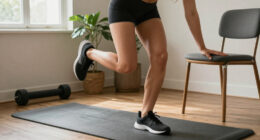
The sequence is a weighted squat for 8–12 repetitions, followed by a standing lunge for 6–8 repetitions on each side. The bridge is prescribed for 10–12 repetitions, and the side-lying leg lift for 8–10 repetitions per side. The report recommends 45–60 seconds of rest between exercises.
Repa advises choosing a resistance that would still allow another two or three controlled repetitions. Her progression is to complete one round at first and try two rounds when more confident with the routine. The source does not provide a specific schedule for how often to do it.
Adding Resistance to Pilates Principles
The workout offers a practical example of how a low-impact, Pilates-inspired session can incorporate weights without making speed or heavier loads the central goal. Its instructions emphasize keeping the feet grounded during squats, maintaining hip position during leg lifts, and coordinating breathing with each repetition.
Repa says the added resistance asks muscles to work harder, while Pilates principles bring attention to movement control. The report describes weight training as a way to support muscle mass and bone health, and Pilates as encouraging posture, mobility and alignment. These are broad potential benefits, not measured outcomes from this specific four-move routine; the article does not report research testing this workout.
Products Worth Considering

LEVOIT Air Purifier for Home, Pets, Bedroom, Smart WiFi

Oral-B iO Series 3 Rechargeable Electric Toothbrush for Adults, Black

Levoit Core 600S-P Smart Air Purifier for Large Rooms up to 2933 ft²
As an affiliate, we earn on qualifying purchases.
A Contemporary Take on Pilates
The report contrasts this routine with what it describes as the original form of Pilates, which revolves around 34 mat movements. It says many contemporary versions incorporate weights or additional exercises, applying Pilates principles to movements outside the traditional mat sequence.
Repa presents weighted exercise as an approachable next step for people who already enjoy Pilates and want more challenge. The workout is not described as a traditional Pilates sequence: its exercises also appear in conventional resistance training, with the distinguishing emphasis placed on breathing, alignment and control.
“If you enjoy Pilates and feel ready for a little more of a challenge, adding weights can be an approachable next step.”
— Victoria Repa, Pilates instructor and founder of the BetterMe workout app
Limits of the Workout Guidance
The source provides exercise instructions and repetition ranges, but it does not report an independent evaluation of the routine or quantify changes in strength, posture, mobility or bone health. Claims about those benefits should not be read as outcomes proven for this particular sequence.
It also does not specify how often to repeat the workout, how to progress the weight over time, or modifications for injuries, pregnancy or other health circumstances. People who are new to exercise or have an existing condition may need individualized advice. The report does not say that the routine is suitable for every reader.
How Beginners Can Progress
The next step set out in the report is to start with one round, use a load that allows controlled form, and consider two rounds only after becoming more confident with the movements. The specified rests are 45–60 seconds between exercises; Repa’s repetition ranges apply separately to each move and side where indicated.
Fit&Well’s article does not announce a follow-up study, training plan or further update. Readers choosing to try the routine can follow the exercise instructions carefully and stop if a movement causes pain. Those with pre-existing health concerns should seek guidance from a qualified health professional before starting or changing an exercise program.
Key Questions
What exercises are in the Pilates-inspired workout?
It includes a weighted squat, a standing lunge with light dumbbells, a weighted Pilates bridge and a side-lying leg lift with a light ankle weight.
How many rounds should a beginner do?
Repa recommends beginning with one round. The report says to try two rounds once you feel more confident with the routine.
How heavy should the weights be?
The report does not set a specific weight. Repa advises choosing resistance that would leave room for another two or three controlled repetitions.
How much rest is recommended?
The routine calls for 45–60 seconds between exercises. It does not give a separate rest schedule between rounds.
Does this routine prove that Pilates weights improve alignment?
No. The article describes the workout’s emphasis on alignment and control, but it does not report a study or measured results showing that this particular routine improves alignment.
Source: fitandwell.com