
TL;DR

Get wellness gear delivered free with Prime
- Fast, free delivery on millions of items
- Prime Video, Amazon Music and more included
- Member-only deals all year
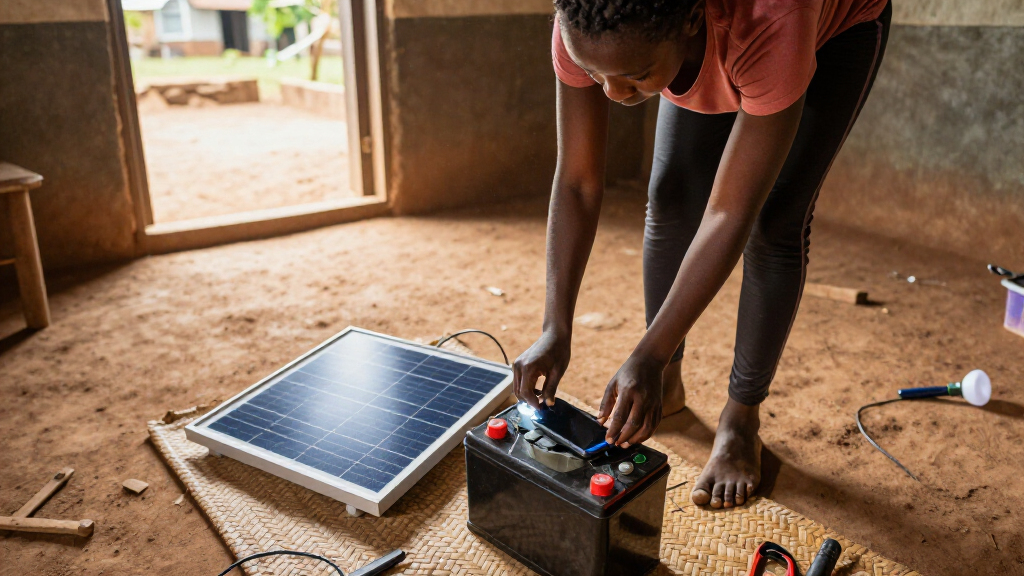
Google says a three-year partnership with Ignite Energy Access has developed mapping and logistics tools to support off-grid solar delivery in sub-Saharan Africa. The companies report 3.7 million devices delivered since 2023 and estimate the partnership enabled more than 160,000 tonnes of CO2-equivalent reductions in the first half of 2026; the estimate has not been independently verified in the source material.
Google says its three-year partnership with Ignite Energy Access has helped the off-grid solar company deliver 3.7 million solar devices across the region since 2023 and enabled an estimated reduction of more than 160,000 tonnes of carbon-dioxide equivalent in the first half of 2026. The work focuses on mapping homes and rural routes, improving supply chains and identifying small solar installations that are difficult to detect in satellite imagery.
In a report published Oct. 26, Google said its researchers, engineers and data specialists worked with Ignite through the company’s Startups for Sustainable Development program for three years, holding more than 100 advisory sessions. The report describes the collaboration as an effort to address practical barriers to reaching households beyond formal electricity grids, rather than a new power-generation project announced on the publication date.
The partners combined satellite imagery with Google’s Open Buildings dataset and routing algorithms to help identify homes that may not appear in standard mapping applications. Google said researchers are developing geospatial models to identify rural paths and account for them in routing. Its operations research models are also being used to assess possible warehouse and mini-hub locations, weighing transport costs, routes, vehicle capacity and inventory expenses.
A separate effort aims to locate rooftop micro-solar systems from space. Google said a single panel can appear as roughly one pixel in standard satellite imagery, making large-scale identification difficult. Researchers are developing computer-vision models using Gemini for Science and fine-tuning them with drone imagery supplied by Ignite. The report says the team is testing thousands of code variations to improve precision and recall; it does not provide performance results for those models.
Reaching Homes Beyond Mapped Roads
The collaboration addresses a delivery problem that can limit access even when solar hardware is available: companies must find dispersed households, navigate poorly mapped roads and plan distribution networks across remote areas. Better location and routing data could help operators direct equipment and staff to places that conventional maps do not represent well. Google’s report describes the tools as a potential repeatable blueprint, but does not quantify changes in delivery time, cost or household electricity access attributable to the models.
The report places the work against a large access gap, stating that more than 600 million people in sub-Saharan Africa live without electricity. It says families may rely on kerosene and candles for lighting. Off-grid solar systems can provide electricity without waiting for extension of a centralized grid, while the scale and distribution of the challenge mean that mapping and supply-chain methods are relevant to deployment plans beyond any single company.
Emissions figures provide one measure of the partnership’s reported climate impact, but they are estimates from Google rather than independently substantiated measurements in the supplied report. The device-delivery figure and emissions estimate therefore describe the company’s account of the program; they do not by themselves establish how many households gained reliable power or the long-term emissions effect.
Products Worth Considering

Oral-B iO Series 5 Rechargeable Electric Toothbrush with Travel Case and 3 Brush Heads, Black

Philips Sonicare 5950 Rechargeable Electric Toothbrush with 2 Brush Heads, Navy

Oral-B iO Series 3 Rechargeable Electric Toothbrush for Adults, Black, with 2 Brush Heads and Travel Case
As an affiliate, we earn on qualifying purchases.
Three Years of Mapping and Delivery Work
Google’s report frames the partnership around three obstacles: homes without formal addresses, difficult rural terrain and the challenge of spotting small solar systems in satellite images. Ignite Energy Access is described as an off-grid clean-energy company with an ambition to connect 100 million people across Africa to electricity by 2030. That is the company’s stated goal, not a result already achieved.
The two organizations are also looking beyond household lighting. Google says they are modeling community-level microgrids that could provide enough power for electric cooking, which requires more energy than an individual rooftop solar kit typically generates. The report says millions of rural families still use wood and charcoal for cooking and describes smoke exposure and fuel collection as concerns. It does not announce a completed microgrid rollout or provide a schedule for one.
“In the first half of 2026 alone, we estimate our partnership with Ignite Energy Access has enabled over 160,000 tCO2e in emissions reductions.”
— Google, in its Oct. 26, 2026 report
Emissions and Model Results Need Detail
The report does not explain the methodology behind the more than 160,000-tonne emissions estimate, specify the counterfactual used to calculate reductions, or state whether an outside party reviewed it. It also does not say how many of the 3.7 million devices are operating, how many households they serve, or how much electricity they supply.
Google describes the mapping and computer-vision work as developing or testing, but gives no accuracy scores, deployment dates or evidence that the models have already changed access outcomes at scale. The report also does not identify the countries covered by the delivery total or provide country-by-country figures. Those details remain unclear from the published account.
Microgrid Planning and Field Results
Google says the partners are preparing a next phase focused on community-level microgrids for electric cooking. It does not provide a launch date, project locations, funding details or a target for households served. Further information would be needed to establish whether the modeling will lead to operating microgrids and what level of power they will provide.
The near-term evidence to watch is whether the mapping tools move from development and testing into wider field use, and whether the partners publish results on route coverage, delivery costs, installations identified and electricity access. Independent detail on how the emissions estimate was calculated would also help readers evaluate the claimed climate impact.
Key Questions
What did Google and Ignite Energy Access report?
Google said the three-year collaboration has supported off-grid solar logistics and mapping. It reported 3.7 million solar devices delivered since 2023 and estimated more than 160,000 tonnes of CO2-equivalent reductions in the first half of 2026.
How are the partners trying to locate off-grid homes?
Google says the team combined satellite imagery, its Open Buildings dataset and routing algorithms to identify homes that may be missing from standard maps. Researchers are also developing models to identify rural paths and improve delivery planning.
Are the solar-mapping models already operating at scale?
The report says researchers are developing and testing computer-vision models using drone imagery from Ignite to identify small rooftop solar systems in satellite images. It does not give accuracy results or say that the models are deployed at scale.
Has the emissions estimate been independently verified?
The source describes the figure as Google’s estimate and does not cite an independent review or provide the calculation method. The basis for the estimate is therefore unclear from the report.
What is planned after the solar work?
Google says the partners are modeling community microgrids that could support electric cooking, which needs more power than a typical individual rooftop solar kit. The report gives no timeline or confirmed rollout locations.
Source: blog.google