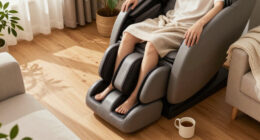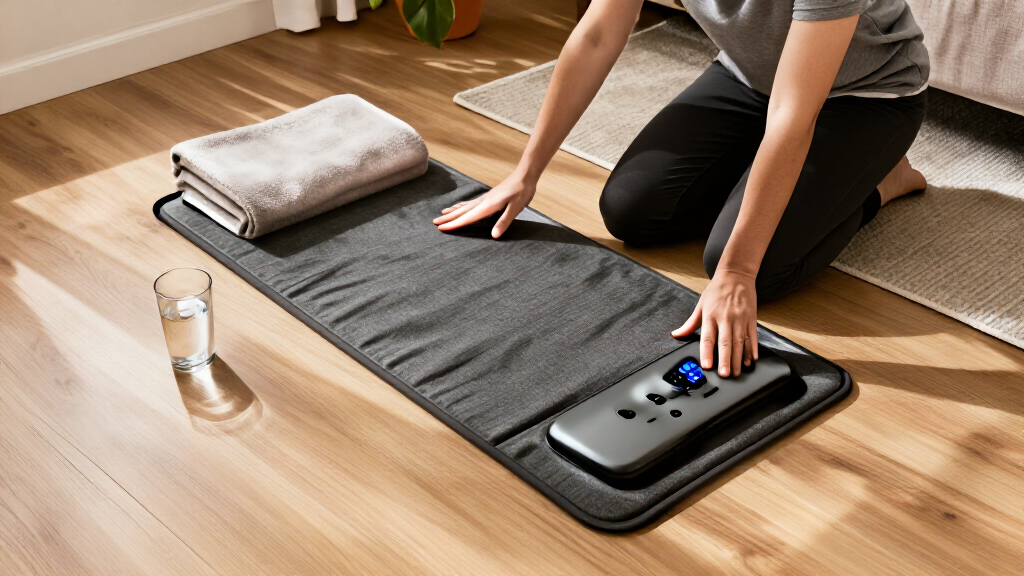

When shoppers compare infrared therapy mats, the real choice is often between a mat designed mainly to provide soothing heat and a more expensive model that layers other features onto that heat. A far-infrared heating mat is the simpler option: it warms the body, offers temperature controls, and may include a timer. A multi-technology mat may add red or near-infrared LEDs, PEMF settings, or mineral materials such as jade and tourmaline.

Get wellness gear delivered free — and shop member deals
- Fast, free delivery on millions of items
- Access to Prime Big Deal Days deals on October 6–7
- Prime Video, Amazon Music and more included

72 x 33-Inch Full-Body Red Light Therapy Mat
- ✔ Dimensions: 72 x 33 inches
- ✔ LED count: 1,400
- ✔ Wavelengths: 660 nm red; 850 nm near-infrared
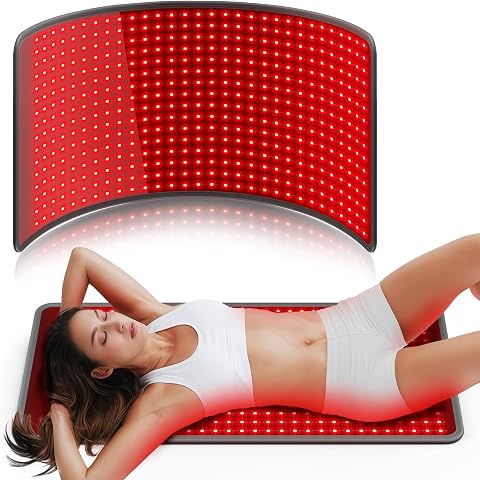
Comfytemp Red Light Therapy Mat, 33 × 17 in, 660 nm and 850 nm
- ✔ Dimensions: 33 × 17 inches
- ✔ LED count: 480
- ✔ Wavelengths: 660 nm and 850 nm
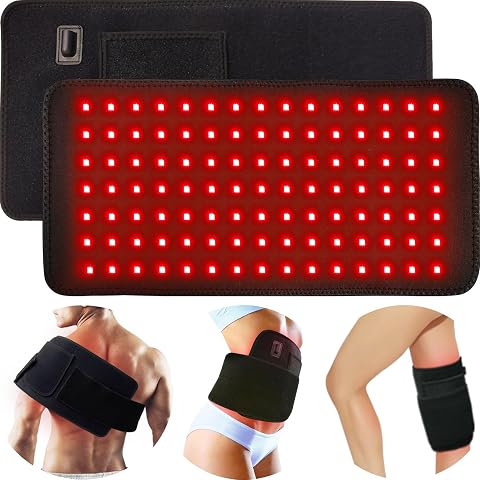
bonodave Corded Red Light Therapy Pad with 660 nm Red and 850 nm Near-Infrared Light
- ✔ Pad dimensions: 16.1 × 7.9 inches
- ✔ Strap dimensions: 35.2 × 4 inches
- ✔ Light wavelengths: 660 nm red and 850 nm near-infrared
Those extras can make a mat more appealing if you want several functions in one device, but they also raise the price and make product claims harder to judge. Neither category should be treated as a proven cure for pain or illness. For most buyers seeking warmth and relaxation, the basic mat is the more sensible starting point. The feature-rich version is a better fit only when its specific additions matter to you, the manufacturer provides clear specifications, and the higher cost fits your budget.
At a Glance
| Criteria | Far-infrared heating mat | Multi-technology infrared therapy mat | Winner |
|---|---|---|---|
| Primary function | Focused on warmth from far-infrared heating elements | Combines heat with one or more additional modalities | Depends |
| Additional features | Usually limited to heat, timer, and temperature settings | May include red-light LEDs, PEMF programs, or mineral layers | B |
| Heat controls and usability | Typically simpler to operate | More settings and functions can add setup complexity | A |
| Evidence and claims | Best understood as a heat product; therapeutic outcomes are not guaranteed | Each added technology needs its own evidence and product-specific specifications | A |
| Safety and practical use | Still requires attention to heat exposure, condition, and manufacturer guidance | More functions mean more instructions and precautions to check | A |
| Cost and value | Usually costs less and avoids paying for features you may not use | Costs more; value depends on whether its added functions are useful and well documented | A |
72 x 33-Inch Full-Body Red Light Therapy Mat
For shoppers who want a mat rather than a small wrap, this is the clear coverage leader. At 72 x 33 inches, it is designed to accommodate much more of the body at once than the Comfytemp’s 33 x 17-inch surface or bonodave’s 16.1 x 7.9-inch pad. Its 1,400 LEDs and listed 660 nm red and 850 nm near-infrared wavelengths give buyers useful specifications to compare, although the LED count alone does not tell us how much light reaches the body.Its controls are also the most flexible in this group: users can choose constant output or 10 Hz and 40 Hz pulse modes, select among five intensity levels, and set a 10–90 minute auto-off timer. That makes it easier to tailor the session format than the Comfytemp, which lists four modes and three intensity levels without a timer duration, or bonodave, which offers a single 10 Hz pulse mode and a 30-minute shutoff. The wipe-clean, sweat-resistant TPU surface is a practical advantage for a large mat that may be used directly against clothing or skin.The tradeoff is the footprint. This model needs more room to lay out and store than either smaller option, and the supplied details do not state power consumption or recommend session length. We would choose it for buyers who prioritize broad coverage and configurable controls, not for anyone seeking a compact pad or clear, evidence-based treatment instructions. Its support and parts-replacement terms add reassurance, but they do not replace independent evidence about outcomes.
Pros:
- Large 72 x 33-inch surface is designed for broad coverage.
- Lists 1,400 LEDs with 660 nm red and 850 nm near-infrared light.
- Three modes, five intensity levels, and a 10–90 minute auto-off timer offer the most control here.
- Sweat-resistant TPU surface is wipe-clean, with stated product support and parts replacement.
Cons:
- Its full-body size is less convenient to move and store than the smaller mats.
- Power consumption and treatment recommendations are not specified.
- Product details do not establish independent evidence for claimed benefits.
Best for: People who have room to lay out a full-body mat and want more control over modes, intensity, and session length.
Not ideal for: Buyers who need a portable, targeted wrap, have limited storage space, or want documented power use and treatment guidance.
Bottom line: We rank it first for broad coverage and adjustable controls, provided its large footprint and missing treatment guidance suit your needs.
“We rank it first for broad coverage and adjustable controls, provided its large footprint and missing treatment guidance suit your needs.”
Comfytemp Red Light Therapy Mat, 33 × 17 in, 660 nm and 850 nm
Comfytemp is the middle-ground pick for buyers who want a flat mat without committing to a full-body surface. Its 33 x 17-inch area is substantially larger than bonodave’s wrap-style pad, so it is more suited to placing under or against a broader section of the body while sitting or lying down. At the same time, it is easier to accommodate than the 72 x 33-inch model, which has nearly full-body proportions and more involved storage needs.The stated 480 LEDs and 660 nm red plus 850 nm near-infrared wavelengths give it a clear feature set, while four light modes and three adjustable levels provide some flexibility without the full-body model’s five levels and defined timer range. Its simple button operation is a benefit for anyone who would rather connect the pad to its adapter and start with uncomplicated controls than manage a strap or several session settings.That simplicity has limits. The mat must stay connected to its adapter, and the supplied information does not give treatment recommendations or evidence for specific outcomes. Unlike bonodave, it is not described with a strap for securing the light around a joint; unlike the largest mat, it does not offer a stated auto-off interval or wipe-clean surface details. We see it as a practical compromise for a stationary, moderate-size setup—not a portable wrap or the most configurable option.
Pros:
- 33 x 17-inch surface offers more flat coverage than the bonodave pad.
- Lists 480 LEDs and both 660 nm red and 850 nm near-infrared light.
- Four modes and three adjustable levels give basic control choices.
- Button operation is straightforward once connected to the adapter.
Cons:
- Requires an adapter connection, limiting use away from a power source.
- No specific treatment outcomes or recommendations are provided.
- No strap or automatic shutoff duration is specified.
Best for: Buyers who want a simple, medium-size flat mat for use while sitting or lying down and do not need full-body coverage.
Not ideal for: People who need a wearable or strap-secured pad, a defined automatic timer, or the broadest possible coverage.
Bottom line: We recommend Comfytemp as the simpler mid-size flat mat, but buyers needing a wrap, full-body reach, or a defined timer should look elsewhere.
“We recommend Comfytemp as the simpler mid-size flat mat, but buyers needing a wrap, full-body reach, or a defined timer should look elsewhere.”
bonodave Corded Red Light Therapy Pad with 660 nm Red and 850 nm Near-Infrared Light
bonodave is the option to consider when a broad flat mat is the wrong shape for the job. Its adjustable 35.2 x 4-inch strap can help position the 16.1 x 7.9-inch pad around areas such as the back, knees, shoulders, hands, or feet. That makes it more adaptable for targeted placement than Comfytemp, which is designed as a flat mat, and more practical for a specific body area than the full-body model if spreading out a large surface is inconvenient.The pad lists 105 beads with 315 chips total, 660 nm red and 850 nm near-infrared light, a 10 Hz pulse mode, and a 30-minute automatic shutoff. Its included adapter and USB controller cable provide the components needed for its corded setup, while the stated 0.44-pound weight makes the pad itself relatively light. The timer is more clearly specified than on Comfytemp, though the full-body mat offers a longer adjustable timer range and more mode and intensity choices.Targeted placement is the main reason to choose it; coverage is the main reason to skip it if you want a mat for lying on or treating a wide area. It requires a nearby power outlet, and the product information does not provide independent evidence for claimed benefits. We would also avoid assuming that the listed chip count or pulse mode means stronger or more effective light than the other products, since comparable irradiance data is not provided.
Pros:
- Adjustable strap supports placement on several body areas.
- Combines 660 nm red light and 850 nm near-infrared light.
- Includes a 10 Hz pulse mode and 30-minute automatic shutoff.
- Adapter, USB controller cable, and user manual are included.
Cons:
- Small pad area is not suited to full-body or broad coverage.
- Corded setup requires a nearby outlet.
- The supplied description provides no independent evidence for claimed benefits.
Best for: People seeking a light pad that can be secured around a smaller area such as a knee, shoulder, hand, foot, or part of the back.
Not ideal for: Buyers looking for a flat surface for lying down, wide-area or full-body coverage, or cordless use.
Bottom line: We choose bonodave for strapped, localized use, while its small coverage and corded design make it a poor substitute for either flat mat.
“We choose bonodave for strapped, localized use, while its small coverage and corded design make it a poor substitute for either flat mat.”
As an Amazon Associate we earn from qualifying purchases.
Key Differences
The meaningful distinction is not simply how many technologies appear in a product description. It is whether you want a heat source or a device combining heat with other features. If your main goal is to warm up while resting, a straightforward far-infrared mat can meet that goal with fewer controls and less expense. Calling the mat “infrared” does not by itself establish a particular health benefit: warmth may feel soothing, but results vary, and it should not replace medical care.
A multi-technology mat can be worth a premium if you specifically want its additional functions and can verify what the product actually provides. Check the wavelength and coverage for light features, the stated parameters and operating instructions for PEMF, and whether the mat’s temperature, timer, materials, and warranty are clearly described. These additions do not automatically make a mat more effective. For a buyer with no defined need for them, the premium is usually poor value; for someone who will use documented features regularly, convenience may justify it.
Detailed Comparison
Primary function (moderate difference)
A far-infrared heating mat has the clearer brief: deliver warmth over a large area. A multi-technology mat also heats, but heat shares attention with its additional functions. Neither category guarantees treatment of pain or another condition. For someone primarily seeking a warming session, Option A is the more direct match. The difference is moderate: Option B still provides heat, but its extra functions change what the buyer is paying for.
Additional features (Multi-technology infrared therapy mat wins — moderate)
Option B wins on breadth because it may combine heat with red-light or near-infrared LEDs, PEMF programs, or mineral components. Option A generally keeps to heating and basic controls. The gap is major if you want those particular functions in one device, but minor if you will use the mat only for warmth. More features are not evidence of better results, so compare the exact specifications rather than relying on a long list of technologies.
Heat controls and usability (Far-infrared heating mat wins — minor)
Option A usually wins for straightforward operation: set the temperature, choose a session length if a timer is available, and use the mat according to its instructions. Option B can require learning separate settings or coordinating heat with other functions. This is a minor-to-moderate advantage, depending on the model. If you value uncomplicated sessions, the simpler mat is easier to live with; if you enjoy adjusting several functions, the extra controls may not bother you.
Evidence and product claims (Far-infrared heating mat wins — moderate)
Option A is easier to evaluate because its core purpose is warmth. That does not prove it will treat a health condition, but the intended experience is relatively clear. Option B needs closer scrutiny: evidence for one modality does not establish the benefits of another, and results from a particular device or setting cannot automatically be applied to every mat. Option A wins modestly on claim simplicity. For either type, treat broad promises of healing or guaranteed pain relief with skepticism.
Safety and practical use (Far-infrared heating mat wins — minor)
Both options can become hot and should be used according to the manufacturer’s directions. People with reduced heat sensation, circulation problems, certain medical conditions, or limited ability to move away from heat should consult a clinician before use. Do not assume a lower setting eliminates risk, and check whether the product is intended for use over clothing, bedding, or direct contact. Option A has a slight practical advantage because it typically involves fewer functions and instructions. Option B is not automatically unsafe, but each added feature brings guidance to review.
Cost and value (Far-infrared heating mat wins — major)
Option A usually delivers better value for a buyer whose goal is heat, because the price is not carrying features they may never switch on. Option B costs more, and that premium makes sense only if its specific additional functions are clearly described and likely to be used. The gap can be major when a feature-rich mat costs substantially more without offering information that helps you judge the feature. Paying extra for a list of technologies alone is not a strong value case.
Far-infrared heating mat: Pros and Cons
Pros:
- Direct, simple choice for people seeking warmth.
- Fewer controls and functions to learn.
- Typically costs less than a multi-technology mat.
- Easier to judge against basic needs such as temperature control, size, timer, and warranty.
Cons:
- Does not combine heat with additional modalities.
- Still may not provide a health benefit beyond a soothing warming experience.
- Quality, temperature consistency, and safety features vary by product.
Multi-technology infrared therapy mat: Pros and Cons
Pros:
- Combines heat with additional features in one device.
- May suit buyers who will use and value specific light or PEMF functions.
- Can offer more session settings and customization.
Cons:
- Usually costs more, sometimes substantially.
- Additional features do not guarantee better outcomes.
- More settings and claims require careful research.
- May be poor value if the buyer mainly wants heat.
Who Should Choose What
Choose Far-infrared heating mat if:
- You mainly want a warming mat for relaxation or comfort.
- You prefer simple controls and do not want to pay for functions you may not use.
- You want to compare products using practical basics such as size, temperature range, timer, warranty, and safety instructions.
Choose Multi-technology infrared therapy mat if:
- You have a specific reason to want an added feature such as red-light LEDs or a PEMF program.
- The product clearly states the relevant specifications, operating instructions, and warranty.
- You expect to use the added functions regularly and can afford the premium without treating it as a substitute for medical care.
Skip both if: Skip both if you need a proven treatment for a medical condition, cannot use heat safely, or a clinician has advised against heat exposure. Ask a healthcare professional about suitable options instead.
Value for Money
For most people seeking warmth, the far-infrared heating mat is the better value. Paying more for a multi-technology model is worthwhile only when you can name the added function you want, verify its specifications, and expect to use it. Otherwise, the extra price buys complexity and claims rather than a dependable improvement in comfort or health. Compare total cost with practical details such as a usable size, clear temperature controls, an automatic shutoff or timer, a solid warranty, and accessible safety guidance. A cheaper product without these basics may not be a bargain, while an expensive mat is not automatically a better one.
Final Verdict
Choose a far-infrared heating mat if your priority is warmth, relaxation, and straightforward operation. It is the better default for most buyers because it focuses on the function they are most likely to use and generally costs less. Choose a multi-technology mat only when one of its additional functions is a real priority, its specifications are transparent, and the higher price is comfortable. The deciding factor is not how many technologies the product lists; it is whether you will use a particular added feature enough to justify paying for it. If you need treatment for a health condition rather than a warming experience, neither mat should take the place of professional medical advice.
Frequently Asked Questions
Are multi-technology infrared mats more effective than basic heating mats?
Not automatically. They offer more functions, but each feature needs to be judged on its own evidence and specifications. A longer feature list does not establish better results for comfort or health.
Does a far-infrared mat treat pain?
Some people find warmth soothing, but a mat cannot promise pain relief or treat the underlying cause. Use it as directed, and seek medical advice for persistent or severe pain.
What should I check before buying either type?
Review the mat’s dimensions, temperature settings, timer or automatic shutoff, materials, warranty, cleaning instructions, and safety guidance. For a multi-technology model, also check the specifications for each added feature rather than relying on broad claims.
Who should be cautious about using an infrared therapy mat?
Anyone with reduced heat sensation, circulation concerns, relevant medical conditions, or difficulty moving away from a hot surface should ask a clinician before using one. Follow the manufacturer’s instructions and stop if use causes discomfort.
Halloween Picks
halloween
As an affiliate, we earn on qualifying purchases.