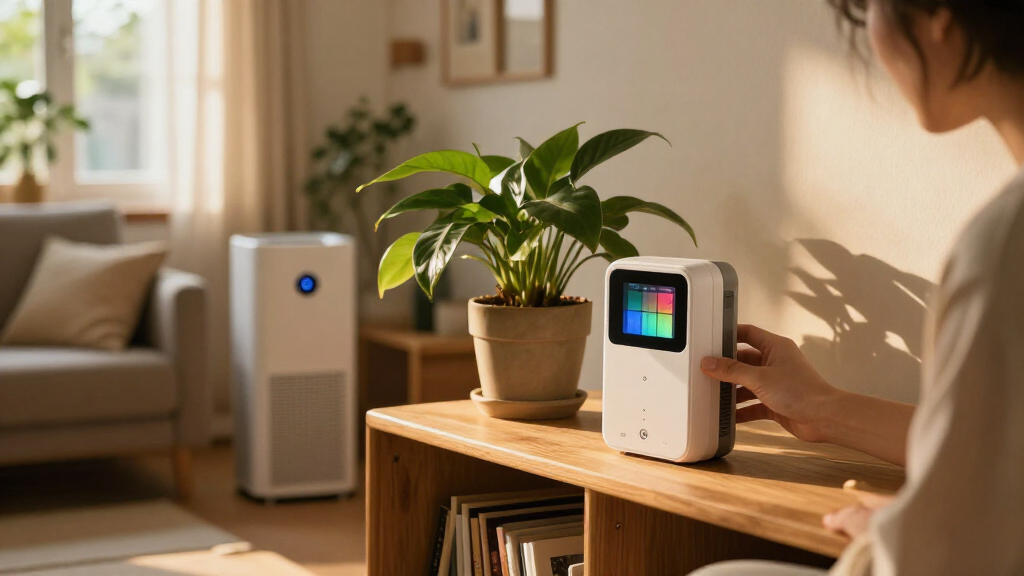
This checklist is for people setting up at-home air quality and wellness technology, whether you are starting with one room or coordinating several devices. It covers monitoring, filtration, humidity control, and ventilation so you can consider the parts of an indoor air setup together.

Get wellness gear delivered free with Prime
- Fast, free delivery on millions of items
- Prime Video, Amazon Music and more included
- Member-only deals all year
The sections are organized by device role: first measure indoor conditions, then consider air cleaning and humidity, and finally look at gas monitoring and ventilation control. Each slot explains what to evaluate and names the selected product, while the checklist points help you compare fit with your home.
Use it by matching each device to a specific need and space. Check room dimensions, placement, power and installation requirements, and whether a product’s stated functions suit your intended use. Confirm details with the product listing and manufacturer before buying, especially where a product name is incomplete.
Indoor air monitor
An indoor monitor can help you keep track of the conditions its sensors are designed to measure. The Airthings View Plus Battery-Powered Radon and Air Quality Monitor is the pick in this slot. Before choosing it, identify which readings matter to you and confirm the product’s sensor list, display or app options, and any setup requirements from its current documentation.
A common buying mistake is treating the phrase “air quality monitor” as a guarantee that every concern is covered. Check the sensor coverage against the readings you actually want, and consider where you can place the unit for representative measurements. Avoid locating it where a nearby vent, open window, or other localized source may skew readings for the room. Check the battery and connectivity details, and make sure the controls and reporting format are comfortable for the people who will use them.
Think about the space as well as the device: one monitor may not describe conditions throughout a multiroom home. Compare the recommended placement guidance and any room-size assumptions in the listing, and decide whether you need monitoring in one area or several. Choose a location you can access for routine checks and follow the setup guidance so the readings are useful over time.
What to look for:
- Confirm the exact sensors and readings included.
- Check battery type, expected life, and replacement access.
- Review display, app, and connectivity requirements.
- Follow placement guidance for the room being monitored.
- Consider whether one unit covers your monitoring needs.
Airthings View Plus Battery-Powered Radon and Air Quality Monitor

The Wi-Fi-connected View Plus continuously monitors radon, PM2.5, CO2, VOCs, humidity, temperature, and air pressure. It runs on batteries, has a customizable eInk display, and uses the Airthings app for readings, trends, and notifications; internet access and an account are required.
Pros:
- Monitors seven air quality measures continuously
- Battery-powered for cable-free placement
- App provides readings, trends, and notifications
- Can connect with other Airthings monitors for multi-room monitoring
Cons:
- Requires the app, an account, and internet access
- Cloud-based data tracking depends on internet connectivity
Best for: Households wanting a battery-powered radon and air quality monitor.
Not ideal for: People seeking readings the device does not measure.
Bottom line: Confirm the sensor list and placement guidance before choosing this monitor.
HEPA air purifier
An air purifier’s usefulness depends on matching its filtration and capacity to the room and the way you plan to run it. The pick here is the PuroAir 240 HEPA Air Purifier, 2-Pack, Black. The two-unit format may suit a plan that calls for placement in more than one area, but check the listing for the intended coverage and operating details for each unit.
A frequent mistake is choosing by the word “HEPA” alone or assuming that a purifier labeled for a large area will work equally well in every layout. Match coverage to the room, and check how the manufacturer defines that coverage and the operating speed used. Review filter replacement availability, maintenance instructions, noise information, and controls before deciding where the units will live. Avoid blocking the intake or outlet with furniture or curtains, and account for the space needed to reach filters for service.
For the two-pack, consider whether both units fit your floor plan and whether you have suitable outlets and open placement locations. Check the dimensions of each purifier and the recommended clearance around it. If you plan to move a unit between rooms, verify its weight and controls are manageable. The best choice is the one whose coverage and upkeep make sense for the rooms you intend to use, rather than a device selected from the product name alone.
What to look for:
- Verify recommended room coverage and its measurement basis.
- Check included filter type and replacement instructions.
- Review noise details at the speeds you expect to use.
- Confirm dimensions, clearance, and outlet access for both units.
- Check filter availability and routine maintenance needs.
PuroAir 240 HEPA Air Purifier, 2-Pack, Black

This air purifier uses a three-layer filtration system with a pre-filter, HEPA filter, and activated carbon to capture dust, pollen, smoke, pet dander, and VOCs. It is designed for rooms up to 1,000 sq.
Pros:
- Three-layer filtration targets common household pollutants, including pet dander and smoke
- Air quality sensor adjusts power when polluted air is detected
- Includes a quiet sleep mode
- Backed by a 2-year warranty
Cons:
- The stated room coverage is based on one hour of operation
- The filtration and health-related benefits are presented as manufacturer claims
Best for: People planning to place a purifier in two areas.
Not ideal for: Homes without suitable placement space for both units.
Bottom line: Check coverage, clearance, and filter upkeep for each purifier.
Smart humidifier
A humidifier should fit the room where you intend to use it and the routine you can maintain. This slot features the 5.8-Gallon Ultrasonic Cool Mist Humidifier for Large Rooms, White. Its name identifies a large-room design and cool mist, but the listing should be checked for actual coverage, controls, and operating instructions before you rely on those labels.
One common mistake is focusing on tank capacity without considering cleaning, refilling, and placement. Plan for regular care: review the manufacturer’s cleaning schedule, water guidance, and access to any parts that need maintenance. Check whether the device has a humidistat or other controls that support your intended routine, and whether automatic shutoff or other functions are documented. Place it on a stable, water-tolerant surface with clearance from electronics, walls, and fabrics, following its manual.
Measure the room and compare it with the maker’s stated coverage rather than assuming that “large rooms” means every open plan or connected space. Also check the unit’s footprint and how you will move or refill it when full. If you are choosing a location near sleeping or living areas, consult the product information for sound and mist placement guidance. A good fit combines room coverage, manageable upkeep, and controls that suit how the space is used.
What to look for:
- Compare stated room coverage with your room dimensions.
- Check tank access, refill method, and cleaning steps.
- Verify controls and any humidity-sensing functions.
- Choose a stable location with suitable clearance.
- Review water guidance and maintenance requirements.
5.8-Gallon Ultrasonic Cool Mist Humidifier for Large Rooms, White

This 5.8-gallon ultrasonic humidifier provides cool mist for spaces up to 2,500 sq. ft.
Pros:
- Large capacity and coverage for whole-home use
- Up to 36 hours of runtime
- Adjustable humidity control and three mist levels
- Top-fill removable tank, remote control, and wheels
Cons:
- Distilled or demineralized water is recommended to reduce mineral residue
- At 12 lb, it may be heavy to move when filled
Best for: People seeking a cool-mist humidifier for a larger room.
Not ideal for: Those who cannot accommodate regular filling and cleaning.
Bottom line: Verify coverage and maintenance needs before placing this humidifier.
Dehumidifier
A dehumidifier is a room-specific appliance, so fit depends on the space, installation conditions, and how collected water will be handled. The named pick is the AEOCKY 5500 sq ft ENERGY STAR Most Efficient 2025 Dehumidifier, up to . The product name ends with “up to,” so confirm the complete model name and current specifications in the listing before comparing capacity or features.
A common mistake is treating a stated square-foot figure as a guarantee for every home. Check the rating conditions and compare them with your room layout and the manufacturer’s guidance. Look at tank size and removal, continuous-drain options if offered, drain placement, controls, and maintenance. Consider the available floor space, access to an outlet, and whether the unit can be moved where needed. Confirm what the listing says about operation and installation rather than inferring details from the title.
Think through the whole routine: how you will empty or drain the unit, reach its filter, and keep airflow unobstructed. Review dimensions and any stated clearance requirements, particularly if it will sit in a utility area or near stored items. If you are comparing energy-related claims, confirm the precise model and applicable label in product documentation. A careful choice balances room suitability and water handling with the maintenance you can sustain.
What to look for:
- Confirm the full model name and current specifications.
- Compare rated coverage conditions with the intended room.
- Check tank access and any documented drainage option.
- Review dimensions, airflow clearance, and outlet placement.
- Verify maintenance steps and any applicable efficiency labeling.
AEOCKY 5500 sq ft ENERGY STAR Most Efficient 2025 Dehumidifier, up to 80 pint/da

The AEOCKY RHEA-001 dehumidifier is certified as an ENERGY STAR Most Efficient 2025 model and can cover up to 5,500 sq ft, removing up to 80 pints of moisture per day in hot, humid conditions. It features a high‑efficiency copper compressor, ultra‑quiet operation as low as 44 dB, and reliable performance down to 65 °F.
Pros:
- Certified ENERGY STAR Most Efficient 2025 for top-tier energy savings
- High dehumidification capacity (up to 80 pint/day)
- Ultra‑quiet operation as low as 44 dB
- Robust copper components and defrost sensors enable reliable low‑temperature performance
Cons:
- Large physical size may be bulky for smaller spaces
- Premium features could result in a higher purchase price
Best for: Shoppers looking for a dehumidifier listed for broad-area use.
Not ideal for: Anyone unable to confirm the incomplete product title and specifications.
Bottom line: Verify the complete model details and drainage setup before buying.
CO2 monitor
Gas monitoring choices depend on the specific gases you need to detect and the setting where the device will be used. The pick named here is the USA NIST Calibrated 4 Gas Monitor by Forensics | O2, CO, H2S, LEL | US. Its title lists oxygen, carbon monoxide, hydrogen sulfide, and LEL, but consult the manufacturer’s documentation to confirm the exact model, intended use, and capabilities.
A key buying mistake is assuming that a multi-gas instrument is a general-purpose indoor air monitor. Match the gases to the task, and check whether the device’s sensor ranges, alarms, calibration process, and operating conditions meet that task. Review documentation for calibration intervals and service requirements, and determine whether the device is intended for continuous monitoring or another usage pattern. Do not infer safety coverage from a product title; verify each relevant function in the manual.
Fit also includes who will operate the monitor and where it will be carried or placed. Check display readability, alarm behavior, power and charging details, and any environmental limits. If it is intended for a particular work or home context, confirm that use with the product maker. A unit’s listed calibration claim does not replace checking its maintenance and operating instructions. Select it only after the sensor configuration and procedures line up with your actual monitoring needs.
What to look for:
- Confirm all four sensors and their ranges in the manual.
- Review alarm behavior and display readability.
- Check calibration process, schedule, and service options.
- Verify power, charging, and environmental operating limits.
- Confirm the device is intended for your use setting.
USA NIST Calibrated 4 Gas Monitor by Forensics | O2, CO, H2S, LEL | USB Recharge

This 4 gas monitor detects oxygen, carbon monoxide, hydrogen sulfide, and combustibles with high accuracy and quick response. It features adjustable alarms, calibration options, and a robust waterproof, dust-proof, explosion-proof design, ideal for professional use.
Pros:
- Accurate detection of multiple gases with fast response
- Adjustable alarms for safety alerts
- Durable, waterproof and explosion-proof design
Cons:
- Requires calibration and maintenance for optimal performance
- Limited to professional or industrial use
- No detailed battery life information provided
Best for: People who need to monitor the gases listed in the product title.
Not ideal for: Those seeking a general indoor air quality monitor.
Bottom line: Verify sensor ranges, calibration, and intended use in the manual.
Smart ventilation controller
A ventilation controller needs to work with the home’s duct layout and the ventilation equipment it is meant to control. This slot names the Panasonic SelectCycler Vent System, 6 Inch Duct. The duct size is part of the product name, but verify the full system configuration and compatibility requirements before planning an installation.
A common mistake is buying a controller based on duct diameter alone. Check system compatibility, including the equipment, wiring, controls, and installation requirements specified by Panasonic. Confirm whether the product is a complete system or requires additional components, and review the installation manual for duct routing and clearances. If you do not have the needed equipment or experience, consult a qualified installer to assess the existing setup and the proposed location.
Measure the available duct path and check access to power and control connections before selecting a mounting location. Compare the documented airflow and control functions with what your ventilation plan requires; do not assume functions based on the word “smart.” Review how the system is operated and maintained, and make sure any connected components are identified in the product documentation. A sound choice depends on verified compatibility and installation fit, not simply a matching nominal duct size.
What to look for:
- Confirm compatibility with the existing ventilation equipment.
- Verify the six-inch duct requirement and any adapters needed.
- Review whether additional system components are required.
- Check wiring, power, mounting, and duct routing instructions.
- Consult a qualified installer when the setup is uncertain.
Panasonic SelectCycler Vent System, 6 Inch Duct

The Panasonic SACG2K-06 SelectCycler Vent System provides whole house ventilation control, coordinating with HVAC systems, dampers, and fans for energy-efficient operation. It includes a programmable wall controller, motorized supply damper, and wall switch, suitable for indoor ceiling mounting.
Pros:
- Provides comprehensive ventilation control for energy efficiency
- Includes programmable controller and motorized damper for convenience
- Designed for indoor ceiling installation with durable materials
Cons:
- Requires connection to HVAC system for full functionality
- Complex setup may need professional installation
- Limited to indoor use
Best for: Homes with a compatible ventilation setup and six-inch ducting.
Not ideal for: Installations with unverified equipment or duct compatibility.
Bottom line: Confirm system requirements and installation fit before choosing this controller.
For a budget-first buying order, start with the measurement or comfort need that matters most in your home, then add devices that address a clearly identified gap. Check current product specifications, required accessories, filters, and maintenance needs as part of each decision so the ongoing setup fits your household.
You can build an at-home wellness setup one practical step at a time. Match each device to its space, verify the details with its manufacturer, and choose the combination that you can install, operate, and maintain comfortably.