TL;DR

Get wellness gear delivered free with Prime
- Fast, free delivery on millions of items
- Prime Video, Amazon Music and more included
- Member-only deals all year
A Fit&Well report recommends a two-minute movement break, made up of four 30-second steps, to interrupt long periods of sitting and create a pause during the workday. Power Plate training director Steve Powell says it is not a cure for stress, and the report does not present evidence that the routine reduces stress levels.
Fit&Well has published a two-minute movement routine for people looking to break up long spells of sitting during the workday, with Power Plate training and education director Steve Powell recommending four 30-second steps. Powell describes the short pause as a way to change posture and reconnect with how the body feels, while stressing that movement is not a cure for stress and cannot undo a demanding week.
The routine, presented in a report tied to National Stress Awareness Day, is intended to fit into a working day without specialist equipment, gym clothes or a dedicated exercise space. The report says the aim is to interrupt a sedentary spell and take a brief pause from the usual routine—not to complete a full workout or make a claim about treating stress.
The first 30 seconds focus on shoulder rolls: sit or stand comfortably, let the shoulders drop away from the ears, roll them backward five times and then forward five times, and gently draw the shoulder blades together before relaxing. Powell’s instructions suggest breathing naturally and noticing any tension around the neck and upper back.
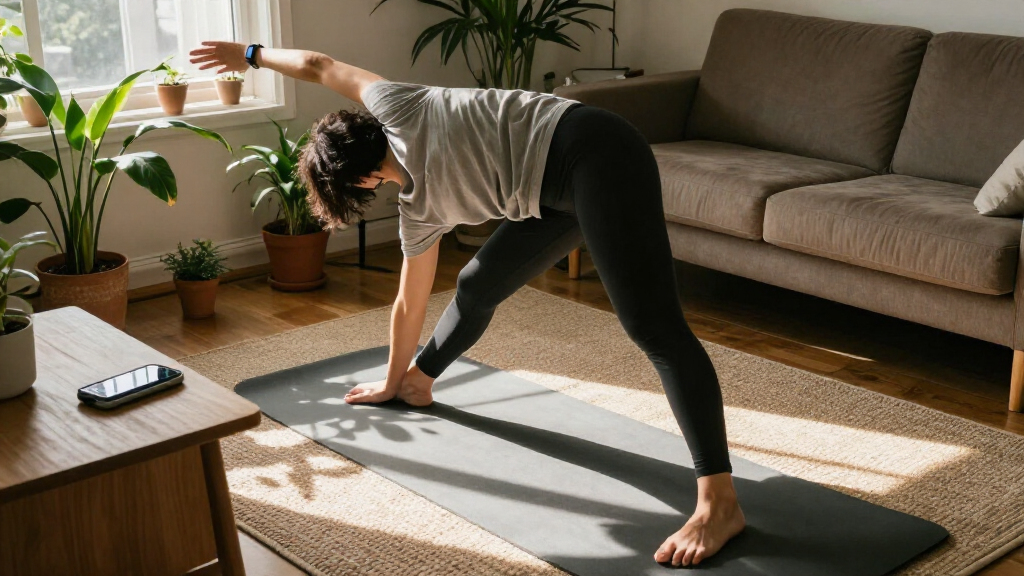
The next two segments are a comfortable chest-opening movement and gentle hip and back mobilization. For the chest, stand with feet hip-width apart, open the arms out to the sides and repeat several times without forcing the stretch. For the hips and back, shift weight from foot to foot, then do a few slow standing side bends within a comfortable range. The final 30 seconds are for standing tall, relaxing the arms, taking a few unhurried breaths and pausing before returning to work.
A Brief Break From Desk Work
The recommendation addresses a common feature of working life: long periods of sitting can leave people feeling stiff, while a busy schedule can make a lengthy workout difficult to fit in. Powell argues that small movements—such as walking around an office or rolling the shoulders between meetings—can make activity easier to work into the day because they do not depend on finding a spare hour.
The value described in the report is modest and practical: a short break offers a chance to change posture and shift attention briefly. It should not be read as proof that the routine lowers stress or replaces other support. Powell explicitly says two minutes will not resolve every source of stress, a distinction that keeps the exercise in the realm of a simple movement pause rather than a treatment.
Products Worth Considering

Garmin Forerunner 55 GPS Running Smartwatch, Black

Levoit Vital Pet Pro Smart Air Purifier

Therabody Theragun Prime 6th Generation Deep Tissue Massage Gun, Black
As an affiliate, we earn on qualifying purchases.
National Stress Awareness Day
The report links the routine to National Stress Awareness Day, which it says has been observed on the first Wednesday in November since 1998. The day is framed as an opportunity to pause and reflect on everyday wellbeing as seasonal pressures and deadlines build.
Powell is director of training and education at Power Plate, a company that makes whole-body vibration devices. Fit&Well identifies him as a movement, performance and coaching specialist with more than 25 years of experience across sport, fitness, wellness and education. His professional background explains why the report attributes the routine to him; it does not, by itself, establish that the sequence has been tested as a stress intervention.
“Our bodies are designed to move, yet modern working life often encourages the opposite.”
— Steve Powell, director of training and education at Power Plate, speaking to Fit&Well
Evidence And Individual Comfort
The report does not provide clinical evidence, measured outcomes or a comparison group showing that this specific two-minute routine reduces stress. Its stated purpose is to break up sitting and offer a moment away from a task; any effect on how a person feels is not quantified.
It is also unclear how the sequence would suit people with injuries, pain or mobility limitations. The instructions say to keep movements comfortable and avoid forcing a stretch, but the report does not discuss individual adaptations. Readers should stop if a movement causes discomfort and seek appropriate professional advice for personal health concerns.
A Routine To Try During Work
There is no announced study, formal rollout or follow-up milestone in the source report. The immediate suggestion is simply to try the four steps during a workday, such as after a period at a screen, and treat them as a brief movement break rather than a substitute for addressing ongoing stress.
Whether the pause helps an individual feel less stiff or more settled will vary, and the report gives no measurement method for tracking an effect. Its practical next step is clear: choose a comfortable moment, move gently for two minutes and return to the next task without expecting the routine to resolve broader pressures.
Key Questions
What are the four steps in the two-minute reset?
It consists of 30 seconds of shoulder rolls, 30 seconds opening the chest, 30 seconds of gentle hip shifts and standing side bends, and 30 seconds standing tall and taking comfortable, unhurried breaths.
Does the routine treat or cure stress?
No. Powell says movement is not a cure for stress and that two minutes will not undo a demanding week. The report describes the routine as a short pause and a way to interrupt sitting.
Do I need equipment or workout clothes?
The report says no specialist equipment, gym clothes or dedicated space are needed. The movements can be done standing, and the shoulder rolls can also be done seated.
What if a movement feels uncomfortable?
The instructions say to move only as far as feels comfortable and not force a stretch. Stop any movement that causes discomfort; people with personal health concerns or movement limitations can seek guidance from a qualified professional.
Source: fitandwell.com