
The best smart water filtration system overall in this lineup is the Waterdrop X16, which pairs reverse osmosis with mineralization and a smart faucet. For a simpler countertop setup, the DREO Countertop RO avoids under-sink installation, while the GE GXWH70M stands out for whole-house filtration and leak detection. The main tradeoff is between broad contaminant reduction from reverse osmosis and easier upkeep from ultrafiltration, along with choices about installation, water output, and connected features. Several Waterdrop models share a platform, so faucet finish alone should not drive a purchase. Read on for the full breakdown and a guide to matching system type to your home.

Get wellness gear delivered free with Prime
- Fast, free delivery on millions of items
- Prime Video, Amazon Music and more included
- Member-only deals all year
Key Takeaways
- The X16 is the strongest all-around fit for buyers who want under-sink reverse osmosis with mineralization and a smart faucet, while its feature set may be more than a basic drinking-water setup needs.
- The GE GXWH70M serves a different job from every under-sink and countertop pick: it filters water for the home and adds leak detection rather than focusing on a single drinking-water tap.
- Countertop RO systems trade installation work for counter space. The DREO and Bluevua RO100ROPOT suit renters or households avoiding plumbing changes, but they require a place to sit and user-managed filling.
- Ultrafiltration is not interchangeable with reverse osmosis. The Waterdrop TSU and TSU-WB are under-sink options for buyers prioritizing fine filtration without choosing an RO system; the contaminant claims and local water report should guide the decision.
- Several G3P600 listings differ mainly by faucet finish. Compare the gold, black, and silver versions on fit, included faucet, and installation details rather than treating the finish as a filtration upgrade.
| Waterdrop T3-C 8-Stage Tankless Reverse Osmosis Water Filtration System, 450 GPD |  | Best Smart RO Balance | Filtration: 8 stages; reverse osmosis | RO membrane pore size: 0.0001 μm | Pure-to-drain ratio: 2:1 | VIEW LATEST PRICE | See Our Full Breakdown |
| DREO Countertop Reverse Osmosis Water Filter System with 3L Tank | 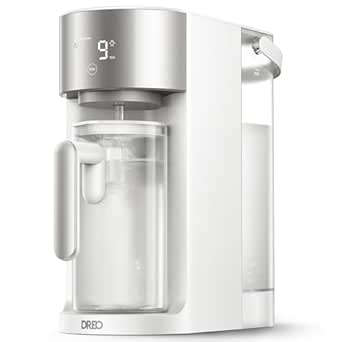 | Best for No-Install Convenience | Purification method: Reverse osmosis | RO membrane pore size: 0.0001 μm | Tank and pitcher capacity: 3 L tank; 1.1 L pitcher | VIEW LATEST PRICE | See Our Full Breakdown |
| GE GXWH70M Smart Whole House Water Filtration System with Leak Detection |  | Best Whole-Home Leak Monitoring | Filtration: Reduces sediment, rust, and other impurities | Compatible filters: FTHPM, FTHTM, FTHLM; sold separately | Filter replacement interval: Every 3 months | VIEW LATEST PRICE | See Our Full Breakdown |
| iSpring RCC7AK-BN NSF Certified, 75 GPD, Alkaline 6-Stage Reverse Osmosis System |  | Best Certified Remineralizing RO | Filtration: 6 stages; reverse osmosis with alkaline remineralization | Maximum supported water TDS: 750 ppm | Certification: NSF/ANSI 58, as stated in product data | VIEW LATEST PRICE | See Our Full Breakdown |
| Waterdrop G5P700A Alkaline Mineral Reverse Osmosis Water Filter, 700 GPD |  | Best High-Output Mineral RO | Filtration: 8 stages; reverse osmosis with alkaline mineralization | RO membrane pore size: 0.0001 μm | Pure-to-drain ratio: 2:1 | VIEW LATEST PRICE | See Our Full Breakdown |
| Waterdrop G3P600 Tankless Reverse Osmosis Water Filter System with Gold Faucet |  | Best Smart RO Pick for a Gold-Finish Kitchen | Model: WD-G3P600 | Installation: Under sink | Purification method: Reverse osmosis | VIEW LATEST PRICE | See Our Full Breakdown |
| Waterdrop TSU-WB 0.01 μm Under-Sink Ultrafiltration Water Filter System |  | Best for Mineral-Retaining Filtration | Purification method: Ultrafiltration | Filtration accuracy: 0.01 μm | Installation: Under sink | VIEW LATEST PRICE | See Our Full Breakdown |
| Waterdrop X16 Tankless Reverse Osmosis System with Alkaline Mineralization and Smart Faucet |  | Best Premium Smart Monitoring | Model: WD-X16-BAS | Installation: Under sink | Purification method: Reverse osmosis with alkaline mineralization | VIEW LATEST PRICE | See Our Full Breakdown |
| Waterdrop TSU 0.01 Micron Ultra Filtration Under Sink Water Filter System |  | Best Compact No-Power Pick | Purification method: Ultrafiltration | Filtration accuracy: 0.01 μm | Installation: Under sink | VIEW LATEST PRICE | See Our Full Breakdown |
| Waterdrop G3P600 Tankless Reverse Osmosis Water Filter System with Black Faucet | 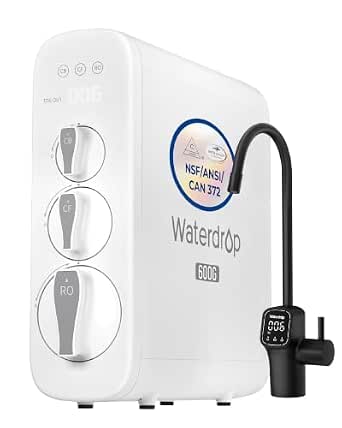 | Best for a Black-Finish RO Setup | Model: WD-G3P600 | Installation: Under sink | Filtration method: 8-stage reverse osmosis | VIEW LATEST PRICE | See Our Full Breakdown |
| Bluevua RO100ROPOT Countertop Reverse Osmosis Water Filter System |  | Best Countertop Smart System | Filtration: Six-stage reverse osmosis with UV light and remineralization | RO membrane: 0.0001 μm | Container: Borosilicate glass carafe | VIEW LATEST PRICE | See Our Full Breakdown |
| Waterdrop G3P800 Tankless Reverse Osmosis Water Filter System, 800 GPD | 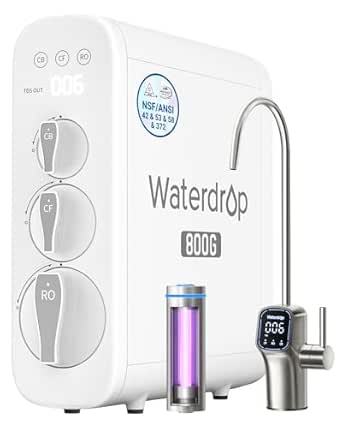 | Best for High-Volume Households | Filtration: 10-stage reverse osmosis | Daily capacity: 800 gallons per day | Pure-to-drain ratio: 3:1 | VIEW LATEST PRICE | See Our Full Breakdown |
| Waterdrop G3P600 Tankless Reverse Osmosis Water Filter System Silver Faucet |  | Best Balanced Under-Sink Pick | Filtration: Eight-stage reverse osmosis | Daily capacity: 600 gallons per day | Pure-to-drain ratio: 2:1 | VIEW LATEST PRICE | See Our Full Breakdown |
| smart water filtration system | Pure-to-drain ratio | Installation | Dimensions | Filtration |
|---|---|---|---|---|
| Waterdrop T3-C 8-Stage Tankles | 2:1 | Under sink; wall-mount option; electrical connection required | 13.39 × 6.22 × 17.95 in | 8 stages; reverse osmosis |
| DREO Countertop Reverse Osmosi | 3:1 | — | 14.5 × 6.7 × 13.4 in | — |
| GE GXWH70M Smart Whole House W | — | — | — | Reduces sediment, rust, and other impurities |
| iSpring RCC7AK-BN NSF Certifie | — | Under sink; non-powered | 15.5 × 16 × 18 in | 6 stages; reverse osmosis with alkaline remineralization |
| Waterdrop G5P700A Alkaline Min | 2:1 | — | 16.69 × 5.69 × 13.9 in | 8 stages; reverse osmosis with alkaline mineralization |
| Waterdrop G3P600 Tankless Reve | 2:1 | Under sink | — | — |
| Waterdrop TSU-WB 0.01 μm Under | — | Under sink | — | — |
| Waterdrop X16 Tankless Reverse | 3:1 | Under sink | — | — |
| Waterdrop TSU 0.01 Micron Ultr | — | Under sink | 14.81 × 4.68 × 13.97 in | — |
| Waterdrop G3P600 Tankless Reve | 2:1 | Under sink | 18.12 × 5.67 × 17.72 in | — |
| Bluevua RO100ROPOT Countertop | 2:1 | — | 10.9 × 15.4 × 14.3 inches | Six-stage reverse osmosis with UV light and remineralization |
| Waterdrop G3P800 Tankless Reve | 3:1 | Under-sink; corded electric | 18.12 × 5.67 × 17.72 inches | 10-stage reverse osmosis |
| Waterdrop G3P600 Tankless Reve | 2:1 | Under-sink; corded electric required | 18.12 × 5.67 × 17.72 inches | Eight-stage reverse osmosis |
More Details on Our Top Picks
Waterdrop T3-C 8-Stage Tankless Reverse Osmosis Water Filtration System, 450 GPD
The Waterdrop T3-C balances under-sink convenience with useful maintenance features: its filter alerts and automatic flushing help owners keep up with upkeep without adding a storage tank. The 0.0001 μm RO membrane and eight-stage setup target contaminants including heavy metals, chlorine, PFOA, and PFOS, while the 450 GPD rating suits regular household drinking and cooking needs. Its 2:1 pure-to-drain ratio also uses less reject water than many traditional RO arrangements.
Compared with the countertop DREO DR-KWF002, this system keeps the purifier and water supply out of sight, but it takes more installation work and needs power under the sink. The faucet requires a drilled countertop hole, and the NSF/ANSI 372 certification listed here concerns material safety, not a stated contaminant-reduction certification. Pick it for connected upkeep and a fixed kitchen setup, not for a no-install solution.
Pros:- Filter alerts and automatic flushing support routine maintenance.
- Eight-stage filtration includes a 0.0001 μm RO membrane.
- Tankless format can be wall-mounted and frees space otherwise used by a storage tank.
- The stated 2:1 pure-to-drain ratio limits wastewater compared with less efficient RO setups.
Cons:- Requires an electrical connection beneath the sink.
- Faucet installation requires drilling a countertop hole.
- NSF/ANSI 372 is the listed certification; no contaminant-reduction certification is specified in the supplied data.
Best for: Households seeking an under-sink RO system with filter reminders, automatic flushing, and a moderate daily capacity.
Not ideal for: Renters or anyone avoiding countertop drilling, electrical connections, or a more involved under-sink installation.
- Filtration:8 stages; reverse osmosis
- RO membrane pore size:0.0001 μm
- Pure-to-drain ratio:2:1
- Filter life:CF: 6 months; CB: 12 months; RO: 24 months
- Installation:Under sink; wall-mount option; electrical connection required
- Dimensions:13.39 × 6.22 × 17.95 in
- Certification:NSF/ANSI 372
Our verdict“Choose the T3-C if you want a fixed, tankless RO system with smart maintenance prompts and can accommodate its power and faucet-installation requirements.”
DREO Countertop Reverse Osmosis Water Filter System with 3L Tank
The DREO DR-KWF002 brings smart features to a countertop RO format: a built-in TDS monitor, filter reminders, automatic pitcher filling, and self-cleaning reduce the routine steps around getting filtered water. Its 0.0001 μm membrane is designed to reduce contaminants including lead, PFOS, PFOA, and fluoride under laboratory conditions. Since it sits on the counter rather than connecting beneath the sink, it avoids the faucet drilling and plumbing work required by the Waterdrop T3-C.
That convenience comes with a capacity limit. The 3 L tank and 1.1 L pitcher are aimed at one or two people, so a busy household may need frequent refills; the T3-C is a better fit for a permanent, higher-throughput supply. DREO’s filter is specified for six months or 265 gallons, so owners should plan for regular replacement. Choose it for easy setup and visible monitoring, not for a large family’s continuous demand.
Pros:- Countertop placement avoids under-sink plumbing and faucet drilling.
- Built-in TDS monitoring and filter-life reminders make system status easier to track.
- Auto-fill and self-cleaning reduce hands-on routine tasks.
- The stated 3:1 pure-to-drain ratio limits water waste.
Cons:- Tank and pitcher capacities are modest for families or frequent cooking.
- Filter replacement is recommended every six months or 265 gallons.
- The countertop unit occupies surface space that an under-sink system such as the Waterdrop T3-C leaves clear.
Best for: One- or two-person households, renters, and countertop users who want RO filtration with TDS monitoring and automated pitcher filling.
Not ideal for: Large households or high-volume kitchens that would find the 3 L reservoir and 1.1 L pitcher restrictive.
- Purification method:Reverse osmosis
- RO membrane pore size:0.0001 μm
- Tank and pitcher capacity:3 L tank; 1.1 L pitcher
- Pure-to-drain ratio:3:1
- Filter life:265 gallons (1,000 L); 6 months
- Maximum supported water TDS:500 ppm
- Dimensions:14.5 × 6.7 × 13.4 in
- Smart features:TDS meter, filter reminder, touch controls, auto-fill sensor, self-cleaning
Our verdict“Choose DREO if you want an easy-to-place smart RO unit for one or two people and do not need a high-capacity household supply.”
GE GXWH70M Smart Whole House Water Filtration System with Leak Detection
The GE GXWH70M takes a different approach from the under-sink RO picks: it treats incoming household water for sediment, rust, and other impurities, while its connected controls add water-use monitoring, leak alerts, and remote shutoff. That whole-home coverage makes it the choice here for people who want to spot a running faucet or respond to a possible leak, rather than focus on drinking-water treatment at one tap. By comparison, the Waterdrop T3-C uses reverse osmosis for a dedicated filtered-water faucet but does not provide whole-house leak controls.
The GE’s smart functions depend on Wi-Fi at the filter location, and the compatible cartridges are sold separately with a three-month replacement interval. It is not an RO system, and the supplied information does not identify specific contaminant certifications or reduction percentages. Pipe compatibility needs checking too: one-inch pipe requires additional fittings. Pick this for connected plumbing oversight, not as a substitute for a dedicated RO purifier.
Pros:- Monitors water use and can alert users to potential leaks or running faucets.
- Remote shutoff adds a way to respond to detected plumbing problems.
- Push-to-connect fittings and a rotating pivot head support installation and cartridge changes.
- Addresses sediment and rust at the whole-home entry point rather than only one drinking-water tap.
Cons:- Compatible filter cartridges are sold separately and are specified for replacement every three months.
- Wi-Fi is required where the filter is installed for connected features.
- One-inch pipe requires additional fittings, and this is not a reverse-osmosis purifier.
Best for: Homeowners who want whole-house sediment filtration paired with Wi-Fi water-use alerts and remote shutoff capability.
Not ideal for: Buyers seeking reverse osmosis or a specified drinking-water contaminant-reduction profile, and homes without reliable Wi-Fi at the installation point.
- Filtration:Reduces sediment, rust, and other impurities
- Compatible filters:FTHPM, FTHTM, FTHLM; sold separately
- Filter replacement interval:Every 3 months
- Connectivity:Wi-Fi required at filter location
- Fittings:3/4-inch push-to-connect; 1-inch pipe requires additional fittings
- Smart functions:Water-use monitoring, alerts, remote shutoff, filter reminders
- Warranty:Limited 1-year entire appliance
Our verdict“Choose the GE GXWH70M for connected whole-house sediment filtration and leak response, but pair it with a separate drinking-water purifier if you need RO treatment.”
iSpring RCC7AK-BN NSF Certified, 75 GPD, Alkaline 6-Stage Reverse Osmosis System
The iSpring RCC7AK-BN is the strongest fit in this group for buyers who prioritize a stated whole-system RO certification and remineralized water over smart connectivity. Its six stages include an alkaline mineral stage, while the transparent first-stage housing offers a visible cue for sediment buildup. The product data states NSF/ANSI 58 certification for the full system and lists reductions for TDS and a range of contaminants. Unlike the Waterdrop T3-C, it does not add filter alerts or automatic flushing; its appeal is a conventional, non-powered setup with a top-mounted faucet fastener intended to simplify faucet installation.
The tradeoff is throughput: 75 GPD is far below the T3-C’s 450 GPD, making this a slower fit for households with heavy demand. The system also uses an under-sink tank-style arrangement and needs space for its 15.5 × 16 × 18-inch footprint. Choose it for certification, mineralized output, and hands-on visual checks—not for smart monitoring or rapid flow.
Pros:- Product data states NSF/ANSI 58 certification for the full RO system.
- Alkaline stage adds minerals after RO filtration.
- Top-mounted faucet fastener is designed to simplify countertop faucet installation.
- Transparent first-stage housing makes sediment buildup visible.
Cons:- 75 GPD capacity is substantially below the Waterdrop T3-C’s 450 GPD rating.
- No smart filter alerts or automatic flushing are specified.
- The under-sink system has a sizable listed footprint and requires room for its components.
Best for: Buyers who want an NSF/ANSI 58-certified under-sink RO system with a mineral stage and do not need app-connected maintenance features.
Not ideal for: High-demand households or shoppers who want tankless installation, smart filter alerts, or a high stated daily output.
- Filtration:6 stages; reverse osmosis with alkaline remineralization
- Maximum supported water TDS:750 ppm
- Certification:NSF/ANSI 58, as stated in product data
- Filter life:6 months
- Installation:Under sink; non-powered
- Dimensions:15.5 × 16 × 18 in
- Operating pressure:70 psi
Our verdict“Choose the iSpring if whole-system NSF/ANSI 58 certification and mineralized RO water matter more than smart alerts, tankless space savings, or faster output.”
Waterdrop G5P700A Alkaline Mineral Reverse Osmosis Water Filter, 700 GPD
The Waterdrop G5P700A pairs a fast stated output with mineralization, making it the strongest match here for a busy kitchen that wants filtered water readily available. Its 700 GPD capacity is higher than the T3-C’s 450 GPD and the iSpring RCC7AK-BN’s 75 GPD, while the 0.0001 μm RO membrane and eight-stage process target contaminants such as lead, fluoride, PFOA, and PFOS. The mineral stage adds calcium, magnesium, sodium, and potassium after filtration, and the 2:1 pure-to-drain ratio limits wastewater relative to systems with less favorable ratios.
Unlike the countertop DREO DR-KWF002, the G5P700A sits under the sink and can connect to appliances such as a refrigerator or ice maker, but that means a more involved fixed installation. It is electric, requires countertop drilling for its faucet, and takes up under-sink space despite its tankless build. The listing mentions NSF/ANSI 58 and 372, but buyers should check which claims apply to their exact system and certification documentation.
Pros:- 700 GPD rating exceeds the T3-C’s 450 GPD and the iSpring RCC7AK-BN’s 75 GPD.
- Eight-stage RO filtration includes a 0.0001 μm membrane and mineralization.
- Tankless design frees space otherwise used by a storage tank.
- 2:1 pure-to-drain ratio and stated connections for compatible appliances add practical flexibility.
Cons:- Requires a powered, fixed under-sink installation and countertop drilling for the faucet.
- Still occupies under-sink space and may be less convenient to install than DREO’s countertop unit.
- The product listing references NSF/ANSI 58 and 372; buyers should verify the exact certification scope.
Best for: Busy households wanting high-output, tankless RO with mineralized water and the option to supply a refrigerator or ice maker.
Not ideal for: Renters, homes without under-sink power, or buyers who cannot drill a faucet hole or verify certification details before purchase.
- Filtration:8 stages; reverse osmosis with alkaline mineralization
- RO membrane pore size:0.0001 μm
- Pure-to-drain ratio:2:1
- Maximum supported water TDS:500 ppm
- Flow rate:1.31 L/min
- Dimensions:16.69 × 5.69 × 13.9 in
- Power and installation:Corded electric; under sink; faucet installation requires countertop drilling
Our verdict“Choose the G5P700A if your household needs faster tankless RO output and mineralized water, and you can accommodate its electrical and installation requirements.”
Waterdrop G3P600 Tankless Reverse Osmosis Water Filter System with Gold Faucet
I’d choose this G3P600 when the goal is reverse osmosis with a coordinated gold faucet, rather than a basic taste-and-odor upgrade. Its eight-stage process and tankless under-sink format suit households seeking a dedicated RO tap without storing treated water in a tank. The smart LED faucet adds a visible system cue at the point of use, while the listed 2:1 pure-to-drain ratio gives buyers a clear efficiency figure to compare. Against the Waterdrop G3P600 with Black Faucet, filtration and flow specifications are essentially the same; the decision is mainly the fixture finish. The tradeoff is a 0.42 gpm maximum flow rate, which can feel slow when filling large containers, plus under-sink installation and a countertop faucet opening to plan for. Its listed NSF/ANSI/CAN 372 certification applies to materials, not a claim that every contaminant is reduced.
Pros:- Eight-stage reverse osmosis filtration in a tankless under-sink system
- Smart LED faucet provides a visible indicator at the tap
- Listed 2:1 pure-water-to-drain ratio
- Gold faucet finish offers a distinct style option versus the black-faucet G3P600
Cons:- Maximum flow rate of 0.42 gpm makes large fills slower
- Requires under-sink installation and a dedicated faucet opening
- NSF/ANSI/CAN 372 certification is for materials and does not establish contaminant-reduction performance
Best for: Homeowners who want tankless RO filtration and a gold-finish smart faucet to match their kitchen fixtures.
Not ideal for: Renters or households avoiding countertop drilling and under-sink plumbing work, and anyone who needs a fast fill rate for frequent large-volume use.
- Model:WD-G3P600
- Installation:Under sink
- Purification method:Reverse osmosis
- Filtration stages:8
- Maximum flow rate:0.42 gpm
- Capacity:600 gallons
- Pure-to-drain ratio:2:1
- Faucet:Smart LED, gold
- Certification:NSF/ANSI/CAN 372
Our verdict“Choose this G3P600 if you want tankless RO and a gold smart faucet; choose its black-faucet counterpart if that finish better fits your kitchen.”
Waterdrop TSU-WB 0.01 μm Under-Sink Ultrafiltration Water Filter System
The TSU-WB suits buyers who want municipal-water filtration without RO wastewater or power. Its 0.01 μm ultrafiltration membrane is paired with smart filter-life indicators and twist-and-pull replacements, so maintenance is easier to track than with a basic mechanical filter. Unlike the Waterdrop X16, it does not use reverse osmosis and does not reduce TDS; that means it retains minerals, but it is not the pick for people seeking lower dissolved-solids readings. The 1.05 gpm maximum flow rate also exceeds the G3P600 models’ 0.42 gpm figure, making everyday dispensing less of a bottleneck. Buyers still need a dedicated faucet opening, and the system is specified for cold municipal tap water—not well water or hot water. Its no-power, no-wastewater design is its defining compromise and advantage.
Pros:- 0.01 μm ultrafiltration membrane with mineral retention
- 1.05 gpm maximum flow rate, faster than the listed G3P600 RO models
- Mechanical operation requires no power and produces no wastewater
- Smart filter-life indicators and twist-and-pull replacement design
Cons:- Does not reduce TDS, unlike the Waterdrop X16 reverse osmosis system
- Specified for cold municipal tap water, not well water or hot water
- Dedicated faucet installation requires a 1-inch countertop hole
Best for: Households on cold municipal water that want a fast-flowing, no-power filter that retains minerals and includes filter-life alerts.
Not ideal for: Well-water users, people who want reduced TDS, or renters who cannot add a dedicated countertop faucet opening.
- Purification method:Ultrafiltration
- Filtration accuracy:0.01 μm
- Installation:Under sink
- Maximum flow rate:1.05 gpm
- Capacity:2,200 gallons
- Filter life:Up to 24 months
- Water source:Municipal tap water
- TDS reduction:Does not reduce TDS
- Power:Mechanical; no power required
Our verdict“Pick the TSU-WB for high-flow municipal-water filtration with mineral retention, but choose an RO system if reducing TDS is a priority.”
Waterdrop X16 Tankless Reverse Osmosis System with Alkaline Mineralization and Smart Faucet
I’d put the X16 first for buyers who want more information and control at the faucet, not just filtered water. Its digital display reports real-time TDS and filter life, and volume control can help dispense a chosen amount without relying on guesswork. The 11-stage RO setup, 0.0001 μm membrane and alkaline mineralization distinguish it from the simpler G3P600, while the listed 3:1 pure-to-drain ratio is also more favorable than that model’s 2:1 figure. Mineralization may slightly raise TDS, so the display can show a higher reading even after filtration; buyers should not treat TDS alone as a complete water-quality measure. This is the most feature-heavy option in this group, but countertop drilling is required, and its larger, heavier under-sink unit needs room for installation.
Pros:- Digital faucet displays real-time TDS and filter-life information
- Volume control supports measured dispensing
- 11-stage RO filtration with alkaline mineralization
- Listed 3:1 pure-to-drain ratio compares favorably with the G3P600’s 2:1 ratio
Cons:- Faucet installation requires countertop drilling
- Mineralization may slightly increase the displayed TDS reading
- At 17.76 kg, the unit requires adequate space and support under the sink
Best for: Homeowners who want tankless RO, mineralization, faucet-based TDS and filter-life information, and measured dispensing control.
Not ideal for: Renters or buyers unwilling to drill for a faucet, and anyone who wants the lowest possible TDS reading without added minerals.
- Model:WD-X16-BAS
- Installation:Under sink
- Purification method:Reverse osmosis with alkaline mineralization
- Filtration stages:11
- RO membrane pore size:0.0001 μm
- Peak flow capacity:1,600 GPD
- Pure-to-drain ratio:3:1
- Monitoring:Real-time TDS and filter-life monitoring
- Certifications:IAPMO R&T tested and certified against NSF/ANSI 42, 58, and 372
Our verdict“Choose the X16 if smart faucet monitoring and volume control justify the added installation and mineralization complexity.”
Waterdrop TSU 0.01 Micron Ultra Filtration Under Sink Water Filter System
The TSU is a practical fit for a crowded cabinet where a tankless system needs to share space with a disposal or other plumbing. Its 14.81 × 4.68 × 13.97-inch footprint and no-power, no-wastewater operation make it a simpler under-sink choice than the RO-based Waterdrop X16. The 0.01 μm ultrafiltration membrane is designed for municipal cold water and retains essential minerals, while the smart panel signals when filters need replacement. Its 1.05 gpm maximum flow rate is also higher than the G3P600 RO models’ listed 0.42 gpm. The clear limitation is that it does not reduce TDS, so it is not a substitute for RO if reducing dissolved solids is the goal. Installation calls for a separate faucet and countertop drilling, and the system is not intended for well water or hot water.
Pros:- Compact under-sink dimensions suit crowded cabinets
- No power supply or wastewater line required
- 1.05 gpm maximum flow rate is higher than the G3P600 RO models’ listed flow
- Smart panel indicates when filters need replacement
Cons:- Does not reduce TDS, unlike the Waterdrop X16 RO system
- Designed for municipal cold water, not well water or hot water
- Separate faucet requires countertop drilling
Best for: Owners of compact kitchens who use municipal cold water and want a no-power filter with a small under-sink footprint and replacement reminders.
Not ideal for: Well-water households, buyers seeking TDS reduction, or renters unable to drill for the included dedicated faucet.
- Purification method:Ultrafiltration
- Filtration accuracy:0.01 μm
- Installation:Under sink
- Dimensions:14.81 × 4.68 × 13.97 in
- Maximum flow rate:1.05 gpm
- Capacity:2,200 gallons
- Filter life:Up to 24 months
- TDS reduction:Does not reduce TDS
- Power source:Mechanical
Our verdict“Choose the TSU when cabinet space, mineral retention, and simple mechanical operation matter more than TDS reduction.”
Waterdrop G3P600 Tankless Reverse Osmosis Water Filter System with Black Faucet
This version makes the most sense when the kitchen calls for a black smart faucet paired with tankless reverse osmosis. Its eight-stage filtration, three pre-installed filters and 2:1 pure-to-drain ratio match the gold-faucet G3P600, so there is no filtration advantage to choosing one finish over the other. Compared with the Waterdrop TSU-WB, this system uses RO rather than ultrafiltration, making it the more relevant choice for buyers who want a membrane-based reduction approach, while giving up the TSU-WB’s faster 1.05 gpm maximum flow. The G3P600 is rated at 0.42 gpm, so filling larger bottles takes more patience. It also needs under-sink installation and a dedicated faucet opening. The listed NSF/ANSI/CAN 372 certification addresses material safety, not specific contaminant-reduction performance.
Pros:- Eight-stage reverse osmosis filtration in a tankless format
- Black smart display faucet offers an alternative finish to the gold G3P600
- Three pre-installed filters are included
- Listed 2:1 pure-to-drain ratio
Cons:- Maximum flow rate is 0.42 gpm, slower than the TSU-WB’s 1.05 gpm
- Under-sink plumbing and a dedicated faucet opening are required
- NSF/ANSI/CAN 372 certification does not establish contaminant-reduction performance
Best for: Homeowners seeking a tankless under-sink RO system whose smart faucet has a black finish to coordinate with their kitchen.
Not ideal for: People who need fast high-volume dispensing, cannot modify the countertop, or want a no-wastewater ultrafiltration setup.
- Model:WD-G3P600
- Installation:Under sink
- Filtration method:8-stage reverse osmosis
- Capacity:600 gallons per day
- Maximum flow rate:0.42 gpm
- Pure-to-drain ratio:2:1
- Dimensions:18.12 × 5.67 × 17.72 in
- Faucet:Black smart display faucet
- Certification:NSF/ANSI/CAN 372
Our verdict“Choose this model over the gold G3P600 when you want the same listed RO setup with a black smart faucet.”
Bluevua RO100ROPOT Countertop Reverse Osmosis Water Filter System
The Bluevua makes the most sense for buyers who want reverse-osmosis filtration without plumbing. Its countertop setup, built-in TDS meter and filter-life display make water quality and maintenance easier to track than on a basic pitcher, while the glass carafe and remineralization stage distinguish it from the under-sink Waterdrop G3P600. UV treatment is another layer in its six-stage system, and the stated 2:1 pure-to-drain ratio helps limit water sent to waste. The tradeoff is capacity and pace: the 1.7-liter carafe and 0.26-liter-per-minute flow suit everyday drinking better than heavy, continuous household demand. At nearly 18 pounds and requiring counter space plus an outlet, it is portable in the sense that it needs no installation, not something I would choose for a cramped kitchen.
Pros:- Countertop operation avoids plumbing and under-sink installation.
- TDS and filter-life display provide useful water-quality and maintenance cues.
- Glass carafe and remineralization stage offer a different serving and taste profile from the Waterdrop G3P600.
- UV treatment and a stated 2:1 pure-to-drain ratio add filtration and water-use features.
Cons:- The 1.7-liter capacity and 0.26-liter-per-minute flow are less suited to repeated high-volume use.
- Its 17.8-pound body and 10.9-by-15.4-by-14.3-inch footprint take meaningful counter space.
- Requires corded power and filter replacement; the listing gives a 12-month filter-life figure despite describing a 12–24-month range.
Best for: Renters or homeowners who want monitored RO water, a glass serving carafe and no under-sink installation.
Not ideal for: Large households that need rapid, high-volume dispensing or people with limited counter space and no nearby outlet.
- Filtration:Six-stage reverse osmosis with UV light and remineralization
- RO membrane:0.0001 μm
- Container:Borosilicate glass carafe
- Capacity:1,700 ml
- Maximum flow rate:0.26 liters per minute
- Pure-to-drain ratio:2:1
- Dimensions:10.9 × 15.4 × 14.3 inches
- Weight:17.8 pounds
- Certification and testing:WQA certified to NSF/ANSI/CAN 372; SGS tested
Our verdict“Choose the Bluevua if you want countertop RO with visible monitoring and a glass carafe; choose an under-sink system like the Waterdrop G3P800 for higher household volume.”
Waterdrop G3P800 Tankless Reverse Osmosis Water Filter System, 800 GPD
The G3P800 earns its place for households that care more about fast, sustained output than countertop portability. Its listed 800 GPD capacity and smart faucet are designed to make filtered water readily available, while the faucet’s TDS readout gives a quick status check without relying on a separate monitor. Compared with the Waterdrop G3P600, this model offers greater stated daily capacity and a 3:1 pure-to-drain ratio rather than 2:1, which can mean less drain water for the same amount produced. The tradeoff is a more involved under-sink setup: it needs an electrical connection and cabinet room, and the faucet display depends on the system being installed in the right spot. Its 10-stage description is not by itself proof of better results; the practical case is capacity, certifications and monitoring.
Pros:- Listed 800 GPD capacity is the highest of these three systems for sustained household demand.
- Smart faucet displays TDS and lights when water is flowing.
- Stated 3:1 pure-to-drain ratio uses less drain water per volume produced than the G3P600’s 2:1 ratio.
- IAPMO R&T certification against NSF/ANSI 58, 42, 53 and 372 is specified in the product information.
Cons:- Under-sink installation requires cabinet space, plumbing work and corded power.
- The smart faucet requires a countertop opening and may complicate installation or replacement.
- Unlike the Bluevua countertop system, it does not offer a portable carafe-based setup.
Best for: Families or frequent home cooks who want a high-capacity under-sink RO system with a faucet-mounted TDS display.
Not ideal for: Renters, households without an under-sink outlet, or buyers who prefer a no-install countertop unit like the Bluevua RO100ROPOT.
- Filtration:10-stage reverse osmosis
- Daily capacity:800 gallons per day
- Pure-to-drain ratio:3:1
- Maximum flow rate:3,028 liters per day
- Smart faucet:TDS display and flow-activated LED
- Installation:Under-sink; corded electric
- Dimensions:18.12 × 5.67 × 17.72 inches
- Weight:15.3 kg
- Certifications:IAPMO R&T certified to NSF/ANSI 42, 53, 58 and 372
Our verdict“Pick the G3P800 for a busy household that values high stated output, efficient water use and faucet monitoring, provided under-sink installation works for your kitchen.”
Waterdrop G3P600 Tankless Reverse Osmosis Water Filter System Silver Faucet
The G3P600 is the more balanced choice for buyers who want tankless convenience and live filter information without selecting the higher-capacity G3P800. Its smart faucet shows TDS and filter life, so I can see water-quality and replacement cues where the water is dispensed. The stated 600 GPD output and 2:1 pure-to-drain ratio suit regular household drinking and cooking, while tool-free filter changes are meant to make routine upkeep less cumbersome. Against the Bluevua RO100ROPOT, this is a fixed under-sink installation rather than a portable countertop appliance; against the G3P800, it has lower stated capacity and a less favorable drain ratio. It still needs electricity beneath the sink and enough cabinet clearance, so the smart features come with a permanent-installation commitment.
Pros:- Smart faucet combines TDS monitoring with a filter-life tracker.
- Tankless construction avoids a storage tank and is designed to save under-sink space.
- Listed 600 GPD capacity supports regular drinking and cooking needs.
- Filters are designed for tool-free changes without moving the system.
Cons:- Requires under-sink electricity and a permanent installation.
- Its 2:1 pure-to-drain ratio is less water-efficient than the G3P800’s stated 3:1 ratio.
- Lower stated capacity than the G3P800 makes it the less fitting choice for the highest-volume households.
Best for: Homeowners seeking an under-sink RO system with faucet-based TDS and filter-life monitoring, but who do not need the G3P800’s higher stated capacity.
Not ideal for: Renters or kitchens without under-sink power, and households that prioritize maximum throughput or a 3:1 pure-to-drain ratio.
- Filtration:Eight-stage reverse osmosis
- Daily capacity:600 gallons per day
- Pure-to-drain ratio:2:1
- Maximum flow rate:0.42 gallons per minute
- Smart faucet:TDS monitor and filter-life tracker
- Installation:Under-sink; corded electric required
- Dimensions:18.12 × 5.67 × 17.72 inches
- Operating pressure:87 psi
- Certifications:NSF/ANSI 58 for TDS reduction; NSF/ANSI 42 for chlorine, taste and odor; NSF/ANSI 372 for lead-free materials
Our verdict“Choose the G3P600 for monitored, tankless under-sink RO at moderate household demand; step up to the G3P800 if capacity and drain efficiency matter more.”
How We Picked
I ranked these smart water filtration systems by how well their filtration format, installation needs, capacity, and connected features match distinct household needs. Reverse osmosis models offer a different treatment approach from ultrafiltration, and neither should be treated as universally better: source-water concerns and the manufacturer’s documented reduction claims matter. I also weighed practical factors such as countertop versus under-sink placement, whole-house coverage, tank or faucet design, and the effort involved in filter replacement.
The ranking favors useful differences, not feature count alone. The Waterdrop X16 leads as a versatile under-sink RO choice with mineralization and a smart faucet; the GE earns a separate role for whole-house coverage and leak detection. Countertop systems rank well for setup flexibility, while the repeated G3P600 variants are grouped by their shared core proposition rather than presented as distinct filtration advances. I give lower priority to systems whose appeal depends on a narrow use case or whose format asks buyers to accept a clear compromise in space, installation, or treatment type.
| smart water filtration system | Installation |
|---|---|
| Waterdrop T3-C 8-Stage Tankles | Under sink; wall-mount option; electrical connection required |
| DREO Countertop Reverse Osmosi | — |
| GE GXWH70M Smart Whole House W | — |
| iSpring RCC7AK-BN NSF Certifie | Under sink; non-powered |
| Waterdrop G5P700A Alkaline Min | — |
| Waterdrop G3P600 Tankless Reve | Under sink |
| Waterdrop TSU-WB 0.01 μm Under | Under sink |
| Waterdrop X16 Tankless Reverse | Under sink |
| Waterdrop TSU 0.01 Micron Ultr | Under sink |
| Waterdrop G3P600 Tankless Reve | Under sink |
| Bluevua RO100ROPOT Countertop | — |
| Waterdrop G3P800 Tankless Reve | Under-sink; corded electric |
| Waterdrop G3P600 Tankless Reve | Under-sink; corded electric required |
Factors to Consider When Choosing Smart Water Filtration Systems
Before choosing a model, decide what problem the system needs to solve: drinking-water treatment at one tap, a no-plumbing countertop setup, or filtration throughout the home. Then match that goal to your water report, available space, and willingness to maintain the unit. These choices matter more than a long feature list.
Match the Filtration Method to Your Water
Start with your utility water report or a suitable test of private-well water, then compare the identified concerns with the system’s published reduction claims. Reverse osmosis and ultrafiltration are not equivalent: they use different filtration approaches and may address different substances. A system’s stage count alone does not tell you which contaminants it reduces or how that claim was verified. Check the exact model’s certification and test documentation rather than relying on broad phrases such as “purifies water.” If your main concern is a specific contaminant, choose based on documented performance for that contaminant, not a general preference for one technology. A whole-house filter also has a different job from a drinking-water system, so do not assume one can replace the other.
Choose the Right Coverage: One Tap or the Whole Home
An under-sink RO or ultrafiltration unit generally targets water at a dedicated drinking-water point, while the GE whole-house option is designed for a broader household role. Whole-house coverage changes the installation and maintenance equation: the system connects to the home’s water supply and may affect water used at multiple fixtures. That can make sense when the concern extends beyond drinking and cooking, but it is not automatically the right answer for a single-tap need. Before buying, confirm your plumbing layout, connection size, available service space, and whether a bypass or professional installation is appropriate. Buyers who only want filtered water for beverages may get a simpler fit from an under-sink or countertop system. Avoid paying for home-wide coverage when your actual goal is limited to one point of use.
Account for Installation, Space, and Daily Routines
Countertop systems such as the DREO and Bluevua avoid an under-sink installation, which can suit renters or households that prefer a movable appliance. Their tradeoff is counter space and hands-on filling, so check the unit’s footprint and how its tank is handled during normal use. Under-sink systems keep the main equipment out of sight but need cabinet room, plumbing access, and a suitable faucet setup. Smart faucets can make status information easier to see, yet they do not remove the need to plan for installation or filter changes. Measure the space before ordering, including room to reach cartridges and tubing. Choose the format that fits the routine you will actually follow, not just the one that looks simplest in a product listing.
Compare Capacity With Household Demand
Published output rates can help compare RO systems, but they are not a complete picture of how convenient a unit will feel at home. Household demand, storage, and dispensing habits all matter: a household that fills several bottles at once has different needs from someone who pours a glass occasionally. Consider how many people will use the system, whether you cook with filtered water, and whether the design includes a tank or dispenses directly. Higher stated output may be useful for frequent use, but it should not outweigh a poor fit for the cabinet, faucet, or maintenance routine. Check the manufacturer’s operating conditions and instructions before comparing capacity figures across different models. If you expect high demand, think about when and how the system replenishes water, not only its headline rate.
Look Beyond Smart Features to Maintenance
Digital indicators and smart faucets can help communicate system status, but they do not make a filter self-maintaining. Replacement schedules, cartridge availability, and access matter because a neglected filter can undermine the convenience of any connected feature. Before choosing, find the recommended replacement intervals for each cartridge and verify that the correct parts are easy to identify for your exact model. Also check whether the system signals a calendar-based change or tracks another measure, since the two approaches may not reflect the same usage pattern. A model with fewer connected features may be a better fit if you prefer a straightforward routine. Treat smart monitoring as a useful prompt, not proof that the water is safe or that every filter is still performing as intended.
Know When Mineralization and Faucet Choices Matter
Some RO models in this lineup add minerals back to treated water, while others focus on filtration without that extra stage. Mineralization is a preference and system-design choice, not a substitute for checking contaminant reduction claims. Consider it if you specifically want that feature, but do not assume every buyer needs it. Faucet style and finish also affect how an under-sink system fits the kitchen, although the gold, black, and silver G3P600 versions share the same basic model identity. Confirm that the included faucet suits your sink layout and that you have a usable installation location before choosing by appearance. If the finish is your main distinction, compare the included components and current model documentation rather than inferring different filtration performance.
Frequently Asked Questions
Should I choose reverse osmosis or ultrafiltration for my home?
Choose based on the contaminants you want reduced and the performance documented for the exact model, not on the technology name alone. The Waterdrop RO options and the TSU ultrafiltration systems serve different filtration approaches, so their claims should not be treated as interchangeable. Check your water report or test results against the product’s published reduction data and certifications. Also compare installation and upkeep, since your preferred treatment method needs to fit your kitchen and maintenance habits. If the concern is unclear, testing the source water before buying can prevent choosing a system that does not address the actual issue.
Is a countertop reverse osmosis system a good choice if I rent?
A countertop system can be a practical choice when you want to avoid modifying plumbing or installing a dedicated under-sink faucet. The DREO and Bluevua models are the relevant options here, but they still need counter space and regular user attention. Check how the unit takes in water, how its tank is managed, and whether its dimensions suit your kitchen. If you move often, portability may outweigh the tidier appearance of a built-in unit. If counter space is already limited or you need a high-volume supply, an under-sink system may fit better despite the installation work.
Does the GE whole-house system replace an under-sink drinking-water filter?
Not automatically. The GE GXWH70M is positioned for whole-house filtration and leak detection, while under-sink RO and ultrafiltration systems focus on water at a particular outlet. Their purposes and documented contaminant claims can differ, so compare them against the concern you are trying to address. A household may use whole-house treatment for one goal and a point-of-use system for another, but that depends on source-water results and product specifications. Check the GE model’s stated reduction claims and installation requirements before treating it as a replacement for a drinking-water filter.
Are the gold, black, and silver Waterdrop G3P600 models different systems?
The listings identify the same G3P600 tankless RO system with different faucet finishes. The finish is not evidence of a filtration upgrade, so buyers should compare the included faucet and installation details rather than assume one version treats water differently. Confirm the exact model number, replacement filters, and package contents before ordering. If you want mineralization, a different output rate, or a smart faucet feature, compare those specifications with other Waterdrop models such as the X16 or G5P700A. Pick a finish that works with your kitchen only after checking that the underlying system matches your needs.
What should I check before buying an RO system with a high output rating?
Read the manufacturer’s operating conditions and compare capacity figures only when they are measured on a comparable basis. A headline output rate does not tell you how the system will fit your household’s actual demand, plumbing, or storage preferences. Check whether it is tankless or includes a reservoir, what faucet it requires, and how much cabinet room the installation needs. Review the filter replacement plan as well, since a system’s ongoing upkeep is part of its real-world fit. For the Waterdrop models in this lineup, compare the stated rates alongside features and installation rather than treating the largest number as an automatic win.
Conclusion
For the broadest combination of under-sink RO treatment, mineralization, and smart dispensing, I recommend the Waterdrop X16 as best overall; buyers seeking a simpler or less feature-heavy setup should compare its added functions with their actual needs. For a best value-style fit, the Waterdrop G3P600 is a sensible shortlist option when its tankless RO format suits the home, with the faucet finish chosen for kitchen fit rather than assumed performance differences. The DREO Countertop RO is my best pick for beginners and renters who want to avoid under-sink plumbing, while the GE GXWH70M is the clearest choice for buyers specifically seeking whole-house coverage and leak detection. For a premium feature set, compare the X16 with the high-capacity Waterdrop G3P800 and G5P700A, weighing their documented features against your installation and demand needs. Choose the TSU or TSU-WB when ultrafiltration is the treatment approach that matches your water concerns, and the Bluevua when countertop RO is the format you prefer. The right system is the one whose verified filtration claims, coverage, and maintenance routine match your household—not simply the one with the most stages or the most connected features.
Black Friday Picks

Garmin Forerunner 265 Running Smartwatch, 46 mm, Black/Powder Gray
As an affiliate, we earn on qualifying purchases.